
India never built its spiritual culture through theories alone. It was shaped by people who lived their philosophy. Some wandered naked in forests, some sang in village streets, some taught kings, and others vanished into the Himalayas leaving behind nothing but a few burning words.
These yogic saints did not create trends. They rewired how India understands life, suffering, freedom, and the Self.
This is not a list of celebrities. It’s a lineage of human beings who refused to live half-awake.
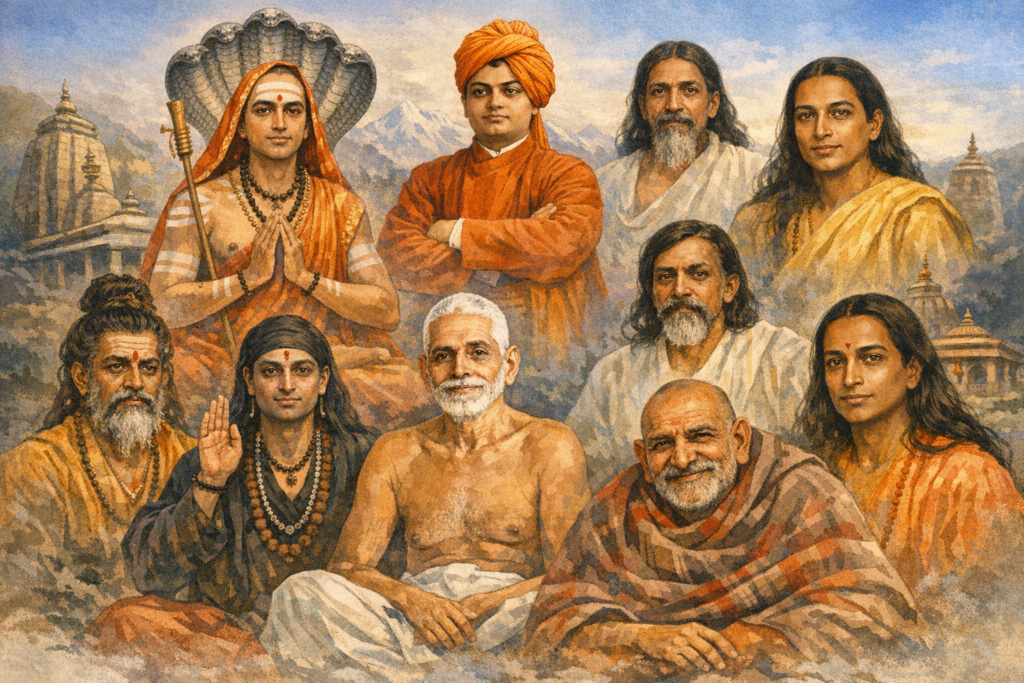
1. Adi Shankaracharya – The Unifier of Vedanta
If Indian spirituality were a scattered library, Shankara was the librarian who organized it.
Born in the 8th century, he walked across the subcontinent before the age of 32, reviving Advaita Vedanta at a time when ritualism and sectarianism had diluted spiritual inquiry.
His core message was blunt:
You are not the seeker. You are the truth you are seeking.
He wrote commentaries on the Upanishads, Bhagavad Gita, and Brahma Sutras, restoring philosophical rigor to spiritual life. His establishment of the four Mathas created a pan-Indian spiritual network that still guides seekers today.
2. Patanjali – The Architect of Yoga
We chant his name before every serious yoga class, but few grasp his scale.
Patanjali systematized yoga into an eight-limbed path — yama, niyama, asana, pranayama, pratyahara, dharana, dhyana, samadhi — transforming mystical insights into a reproducible science of consciousness.
His Yoga Sutras do not offer comfort. They offer precision.
“Yoga is the cessation of the fluctuations of the mind.”
No drama. No poetry. Only clarity.
3. Maharshi Patanjali? No — Sage Kapila – Father of Sankhya
Long before modern psychology, Kapila mapped the inner universe through Sankhya philosophy.
He broke reality into its components so the seeker could stop confusing the machine with the witness. His teaching formed the metaphysical backbone of classical yoga.
Kapila did not teach devotion or surrender. He taught discrimination — the radical clarity that separates awareness from experience.
4. Gorakhnath – The Rebel Yogi
If Shankara brought order, Gorakhnath brought fire.
Founder of the Nath yogi tradition, Gorakhnath rejected caste boundaries, temple dependency, and blind ritual. He carried yoga to the masses — farmers, laborers, wanderers — turning spirituality into a living street tradition.
His methods were intense: hatha yoga, internal alchemy, mastery over breath and bodily energies.
He didn’t ask seekers to behave.
He asked them to transform.
5. Ramana Maharshi – Silence as Teaching
At sixteen, Ramana had a spontaneous awakening that erased the fear of death. He left home and spent decades in silent absorption at Arunachala hill.
He did not teach yoga postures or complex metaphysics.
His entire method was one question:
“Who am I?”
People came with problems. They left with fewer identities.
Ramana’s presence did not comfort the ego. It dissolved it.
6. Swami Vivekananda – The Global Ambassador
Without Vivekananda, yoga might still be locked inside Indian ashrams.
At the 1893 Parliament of Religions in Chicago, he introduced Vedanta to the West not as mysticism, but as a science of the soul. He reframed spirituality for modern minds — rational, inclusive, practical.
His words still echo:
“Arise, awake, and stop not till the goal is reached.”
Yoga became not withdrawal — but power in action.
7. Sri Aurobindo – The Mystic of Evolution
Aurobindo did not aim for escape from life. He envisioned the divinization of life itself.
His Integral Yoga was radical: instead of fleeing the world, transform consciousness within it. He spoke of a future humanity, guided by supramental awareness.
Politics, poetry, yoga — he blended them all into a vision of spiritual evolution.
8. Lahiri Mahasaya – The Householder Yogi
Most saints renounced society. Lahiri Mahasaya mastered yoga while living as a government clerk with a family.
He revived Kriya Yoga — a powerful technique of spinal energy circulation — making advanced spiritual practice accessible to ordinary people.
He proved enlightenment does not require escape from responsibility. It requires intimacy with awareness.
9. Mahavatar Babaji – The Timeless Mystery
Little is known. Much is whispered.
Babaji is described as an immortal yogi who revived Kriya Yoga through Lahiri Mahasaya. Whether historical or symbolic, his presence looms over modern yogic traditions as a reminder:
Not all masters leave footprints.
Some leave frequencies.
10. Neem Karoli Baba – The Saint of Love
In a tradition heavy with discipline, Neem Karoli Baba introduced a shocking method: love everything.
His devotees included Western seekers like Ram Dass, Steve Jobs, and countless silent wanderers. His teachings were absurdly simple.
Feed people.
Serve.
Repeat God’s name.
Love until there is no “you” left to love.
He did not teach yoga as technique. He lived it as devotion in action.
The Thread That Connects Them All
These saints were not clones. They argued, contradicted, and diverged wildly.
Yet they all pointed to one truth:
Your life is not meant to be survived. It is meant to be realized.
Some taught with books.
Some with silence.
Some with rebellion.
Some with love.
Together, they shaped Indian spirituality into a living, breathing organism — one that still whispers to anyone willing to listen deeply enough.