
There’s a particular hush in an Ashtanga class right after the opening chant, the kind of quiet that feels like everyone is holding the same breath. If you’ve ever sat there, palms together, wondering what comes next (or why the person two mats over looks like they were born bending in half), this is for you. Think of the Ashtanga series as a mountain range: each series is another ridge, steeper and narrower than the last. You don’t need to summit every ridge, but smelling the air on each one helps you know whether you’re ready to climb.
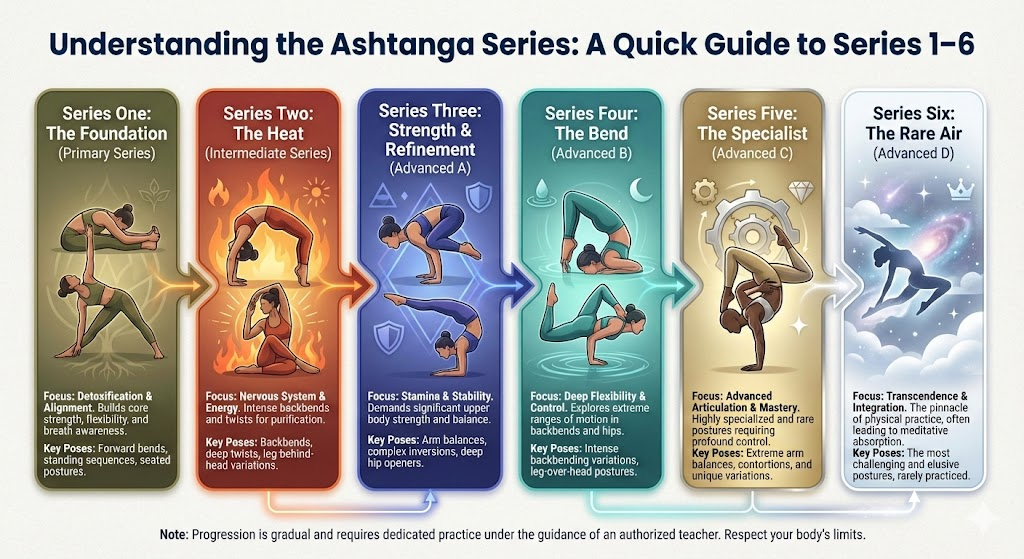
Series One: The Foundation (Primary Series)
Series One is the map. It’s often called Yoga Chikitsa yoga as therapy and it shows you the basic topography of breath, bandha, vinyasa. Expect sun salutations, standing poses that feel like they build a spine from the ground up, and seated work that invites you into quiet. It’s disciplined and honest. If you practice it regularly, you’ll notice small, steady changes: steadier breath, a quieter mind, hips that stop whispering complaints when you sit cross-legged.
Funny memory: I once tried Series One on a week I’d eaten two very guilty slices of pizza. The pizza won in the first half of practice. But by savasana, the body said thank you anyway. That’s the gentle magic of this series it will show you where you are, without judgement.
Series Two: The Heat (Intermediate Series)
Series Two turns up the thermostat. There’s more twisting, longer standing balances, deeper binds. It’s where flexibility starts to mix with tenacity. This series asks: can you stay present when your edges burn? You’ll find shapes that feel like puzzles; some pieces fit quickly, others keep resisting. The reward is not just a new posture but a new steadiness under pressure.
If Series One is building the house, Series Two is installing the windows it opens you out.
Series Three Strength & Refinement (Advanced A)
Here the practice becomes less about the list and more about nuance. It’s about the way you move between poses, how you use the breath to thread through transitions. Strength becomes precise. You’ll play with inversions and arm balances in a way that feels sculptural. This series can be humbling and that’s precisely why it’s valuable. Humility is a practical teacher; it shows you exactly where ego still lives in the body.
Series Four The Bend (Advanced B)
Series Four folds you into more complex shapes. Think deeper backbends, more intricate internal rotations, and an emphasis on subtle opening. It’s less about showing off and more about inner architecture: how the spine curves, how the ribs anchor, how the breath supports a backbend that otherwise would be all ego and no foundation.
A side note: the first time I attempted one of those long backbends, I left the room feeling like I’d laughed for an hour. There’s bliss in surrender and sometimes a very human amount of wobble.
Series Five The Specialist (Advanced C)
Series Five begins to feel like a specialist’s manual. Poses are rarer, sequences more selective. This is the place for long-term practitioners who are refining very specific edges: opening tight threads without forcing, balancing strength with surrender, letting technique do the work so the body can be honest.
Series Six The Rare Air (Advanced D)
Not many reach Series Six, and that’s okay. It’s for the practitioners who’ve lived with the practice for years and whose bodies and breath have matured into a quiet expertise. Think of it as the northernmost ridge thin, beautiful, and not necessary for everyone. The benefits, if you choose to seek them, are subtle and profound: a heightened sensitivity to alignment, breath, and the small economies of movement.
How to Approach the Series (Without Getting Overwhelmed)
First, drop the scoreboard. Ashtanga is not a checklist. It’s a conversation between your breath and your body. Show up, do the work, leave the expectations at the door. If you’re new, focus on Series One until it stops feeling new. If you’ve been practicing for a while and are drawn to the next series, test the waters slowly a few poses here and there, not a full migration.
Practice consistently rather than intensively. Ten honest minutes daily beats a sporadic three-hour sprint. Rest matters; in fact, rest is part of the practice. When you rest well, your edges soften and paradoxically, you grow.
Tips I Wish Someone Told Me Early On
- Learn to breathe through the transitions. The moments between poses are where the practice actually deepens.
- Keep a notebook. Not for posture scores, but for impressions: what felt sharp, what surprised you, what humbled you. Years later, those notes read like a map of inner weather.
- Patience is not passive. It’s active and curious. You can be ambitious without being impatient.
A Final Thought
Ashtanga is a lineage and a method, but mostly it’s a mirror. Each series reflects a different facet of practice, the structural, the fiery, the refined, the rare. Your relationship to the series will change over time, just as you do. Some seasons you’ll love the steadiness of Series One; others you might be called to the daring of Series Three or Four. And sometimes, not practicing at all (yes, really) is the most honest practice available.
So, the next time you sit, breathe, and chant, try to hear the practice as an invitation rather than a test. Walk toward the mountain that calls you that day. If you climb a little, that’s enough. If you climb far, great. Either way, you’ll come home with a clearer breath and, perhaps, a quieter mind.