
There’s a kind of ancient practicality to Sankhya Darshan that feels almost modern: it asks basic questions and refuses fuzzy answers. Who am I? What is the world made of? How do I stop suffering? If those questions sound dramatic, that’s because they areSankhya philosophy treats them like plumbing problems: clear the pipes and the water flows. Below I’ll walk you through its core ideas without the Sanskrit-heavy fog. Think of this as a map, not a textbook.
Origin and background of Sankhya philosophy
Sankhya Darshan is one of the oldest schools of Indian thought. It grew out of a time when people were trying to make sense of experience using observation and reason, alongside spiritual insight. Unlike scriptures that demand faith first, Sankhya leans on analysis. Traditionally attributed to the sage Kapila, it matured over centuries and influenced other systemsparticularly Yoga and certain strands of Vedanta. If you imagine Indian philosophy as a bustling city, Sankhya would be the meticulous surveyor who draws the grids and measures the plots.
Purusha and Prakriti
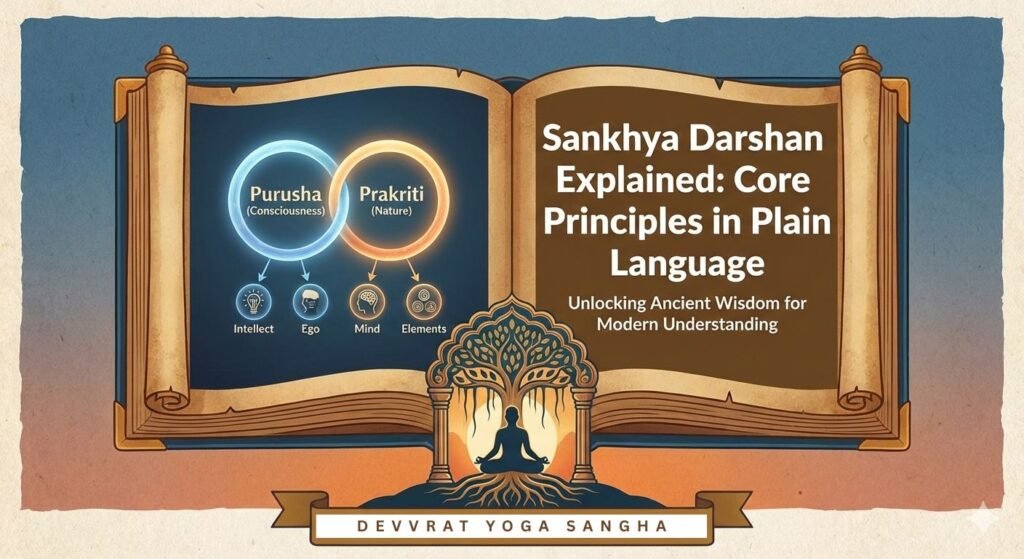
At the core of Sankhya are two eternal realities: purusha and prakriti. Purusha is pure consciousness, the witness, the silent presence inside you that notices thoughts, feelings, and sensations. Prakriti is nature: mind, matter, energy the whole show of change.
This duality isn’t about good vs. bad. It’s more like stage and audience. Purusha watches; prakriti performs. Trouble arises when the audience starts believing it’s the actor. We confuse our thoughts and feelings with who we truly are. Sankhya’s job is to help the witness wake up to itself.
A tiny, perhaps silly personal image: imagine you’re watching a stormy film while sipping tea. The movie (prakriti) is loud, dramatic, and makes your heart race. Purusha is the person in the seat who loves films and notices their reactions. Sankhya whispers: “Hey, you’re not the movie. You’re the one watching.”
The 25 tattvas
Sankhya explains creation through a sequence of twenty-five principles called tattvas basic building blocks of reality. They begin with prakriti (the primal matter), move through intellect and ego, through mind and senses, and eventually produce the elements and individual bodies. Purusha is counted as the twenty-fifth, the conscious observer standing apart.
You don’t need to memorize all twenty-five to get the point. The sequence is a way to show how complexity arises from simplicity: the same material principle rearranges into thoughts, senses, and bodies. It’s an early model of emergent complexitysimple rules producing rich, surprising forms. That should feel familiar to anyone who’s watched a seed become a tree or built something from a handful of LEGO bricks.
The three gunas
If prakriti is the raw material, then the three gunas are its temperament. Every object and mind is composed of sattva, rajas, and tamas qualities that shift and mingle.
- Sattva = clarity, balance, harmony. When sattva predominates, perception is calm and clear.
- Rajas = activity, movement, desire. Rajas fuels change, ambition, restlessness.
- Tamas = inertia, heaviness, confusion. Tamas dulls and resists.
These aren’t moral labels; they’re descriptive. Your morning cup of coffee might be rajasic; a well-rested, focused afternoon could be sattvic; that week you stayed in bed bingeing showstamas. Sankhya teaches that psychological states and even physical conditions arise from shifts in the gunas. Freedom, then, isn’t about making tamas vanish or worshipping sattvabut learning to notice the mix and choose responses with clarity.
Liberation in Sankhya
Liberation (kaivalya) in Sankhya is simple and radical: recognize purusha as distinct from prakriti. When the witness stops identifying with the drama of mind and body, suffering loosens its grip. It’s not an escape hatch; it’s a steadying recognition. Imagine finally understanding the script of a movie you’ve run your whole life suddenly the scary parts don’t terrify you in the same way.
This liberation is achieved primarily through discernment (viveka): discriminating between what changes and what doesn’t, between the watcher and the watched. No mystical tricks requiredjust clear seeing. That said, Sankhya often pairs with yogic practices because disciplined attention and ethical habits make discernment easier.
Role of Sankhya in yoga philosophy
Sankhya and yoga are like close cousins. Classical Yoga (Patanjali) borrows Sankhya’s metaphysicspurusha/prakriti, tattvas, gunasand builds a practical path (asana, breath control, ethical discipline, meditation) to help purusha realize itself. Where Sankhya asks “what is this?” Yoga asks “how do we act?” Together they answer both: what the human condition is, and how to work with it.
If you’ve ever practiced mindful breathing and suddenly felt some emotional clutter settle, you’ve experienced Sankhya’s insight in motion: clarity arises when the witness is strengthened.
Practical examples from daily life
Sankhya isn’t only for monasteries. Its categories help us in ordinary moments.
- Anxiety morning? Notice the rajasic churning rest, breathe, and let clarity (sattva) increase through small habits: consistent sleep, gentle movement, focused breath.
- Overeating or lethargy? Tamas may be high. Movement, sunlight, and social connection often lift it.
- Creative flow? You’re riding a helpful mix of rajas and sattvaactive but clear.
Another practice: when upset, pause and ask, “Who is noticing this upset?” That pause creates distance. Not always dramatic, but cumulatively powerful.
Key takeaways
Sankhya Darshan offers a clear, almost clinical map of mind and matter. Its core gifts:
- A clean distinction between purusha (witness) and prakriti (nature).
- A stepwise model (the 25 tattvas) showing how experience arises.
- The three gunas sattva, rajas, tamas as practical levers for understanding states of mind.
- Liberation as simple discernment: knowing the watcher from the show.
If you want a philosophy that matches well with modern psychology and practical yoga, Sankhya is surprisingly relevant. It doesn’t promise miracles. It offers an invitation: look carefully, name what you see, and practice choosing how you respond. Small acts of claritynoticed breaths, honest journals, gentle shifts in routine are Sankhya in action. Try that for a month and see what quietly changes.