
The first time I opened the Sankhya Karika, I remember thinking, This is it? Just short verses. No stories. No metaphors. No hand-holding. It felt like being handed a neatly folded map with no labels and being told, “You’ll figure it out.” And strangely, that’s part of its charm.
The sankhya karika doesn’t try to impress you. It doesn’t persuade or preach. It simply lays things out, step by step, and trusts that if you sit with it long enough, clarity will arrive on its own. This guide is meant to help you do exactly thatwithout stripping the text of its quiet power.
What is the Sankhya Karika
The Sankhya Karika is a compact classical text that distills the entire Sankhya system into verses that are deceptively simple. Think of it as the user manual for Sankhya philosophy. Where other texts wander, this one gets straight to the point. No rituals. No mythology. Just analysis.
It belongs to the tradition of karika literatureshort, aphoristic verses designed for memorization and commentary. That’s important. The text was never meant to be “read once and understood.” It was meant to be lived with. Recited. Revisited. Misunderstood at first. Understood later.
Who wrote the text and when
The Sankhya Karika is attributed to Isvarakrishna, likely composed sometime between the 3rd and 5th century CE. We don’t know much about him as a person, and honestly, the text doesn’t seem interested in his biography either. That anonymity feels intentional.
Isvarakrishna wasn’t inventing Sankhya from scratch. He was systematizing an already ancient philosophical stream, refining ideas that had circulated for centuries. His genius wasn’t originality it was clarity.
Structure of the Sankhya Karika
The text consists of around 70 concise verses. Each one builds logically on the previous, forming a clean philosophical arc:
- Why suffering exists
- What reality is made of
- How experience unfolds
- Why liberation is possible
- How knowledge, not action, brings freedom
There’s a feeling of inevitability to the structure. Once you accept the starting assumptions, the rest follows almost mathematically. This is why the sankhya philosophy text often feels closer to science than religion.
Key verses every beginner should know
You don’t need to understand every verse immediately. But some verses act like hinge sonce they open, the rest of the text starts to move.
Verse on Purusha
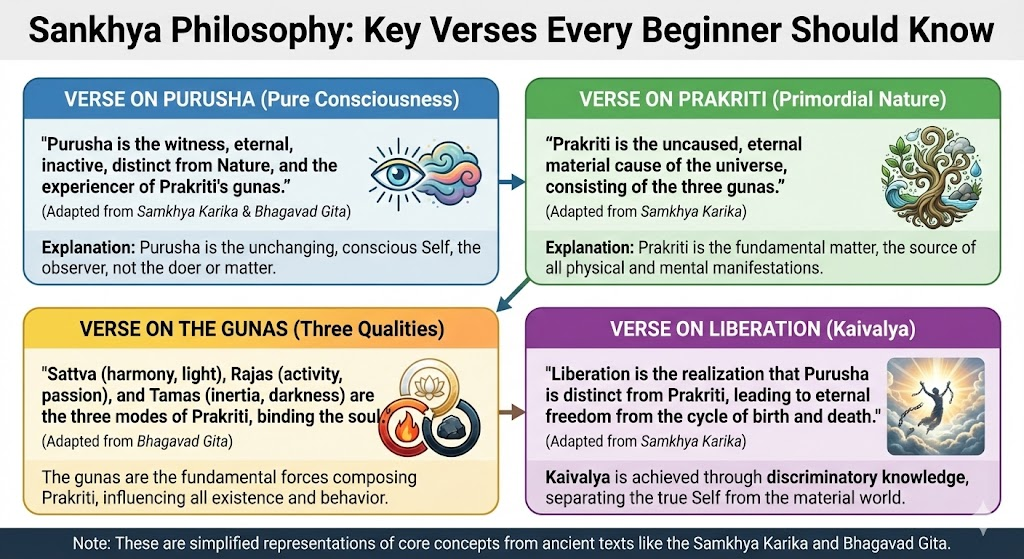
One of the foundational sankhya karika verses explains purusha as multiple, passive, and conscious. Purusha doesn’t act. It doesn’t change. It simply witnesses.
This is often confusing at first. We’re so used to identifying with thoughts and emotions that the idea of a silent observer feels abstract. But pause for a moment. Notice that you’re aware of your thoughts. That awareness itself doesn’t argue or plan. That’s the territory Sankhya is pointing to.
The verse isn’t mystical. It’s observational.
Verse on Prakriti
Another key verse describes prakriti as uncaused, productive, and unconscious. It’s the engine of change. Everything that moves, evolves, thinks, reacts comes from prakriti.
The brilliance here is the separation. Experience is dynamic, but awareness isn’t. Confusion arises when we mix the two. Sankhya doesn’t say the world is an illusion. It says the mistake lies in misidentification.
A helpful image I once heard: purusha is the light; prakriti is the film playing in that light.
Verse on the gunas
Several verses explain the three gunas sattva, rajas, and tamasas the basic forces shaping prakriti. These aren’t moral categories. They’re tendencies.
- Sattva clarifies
- Rajas activates
- Tamas stabilizes and obscures
Every mental state, every action, every habit is some combination of these three. The text doesn’t ask you to eliminate any of them. It asks you to see their movement clearly.
That alone is liberating.
Verse on liberation
One of the most striking verses states that liberation happens not because prakriti stops, but because purusha recognizes it is distinct. The world continues. The body continues. But suffering loosens its grip.
There’s no dramatic escape here. No cosmic fireworks. Just recognition. Almost anticlimactic. And somehow, deeply reassuring.
How to read the Sankhya Karika as a student
If you treat the sankhya karika like a normal book, you’ll miss it. This text rewards slowness.
Read a few verses at a time. Sit with them. Let them echo into daily life. Notice where the ideas show up in your reactions, your frustrations, your moments of clarity. Commentary helps, but don’t let explanations replace direct reflection.
And accept confusion. It’s part of the process. Sankhya sharpens discernment by first showing you where your thinking blurs.
Common misconceptions
One common misunderstanding is that Sankhya is pessimistic. It starts with suffering, yes but only to analyze it. Doctors talk about illness so they can treat it.
Another misconception is that Sankhya is anti-action. It’s not. It simply says action belongs to prakriti, not purusha. When that’s understood, action becomes lighter, less tangled in ego.
Some also think Sankhya contradicts yoga. In reality, yoga supplies the discipline; Sankhya supplies the map. They’ve been walking together for centuries.
Conclusion and study tips
The Sankhya Karika doesn’t aim to inspire you. It aims to clarify you. That’s a different kind of gift.
Study it patiently. Revisit verses you don’t understand. Let the logic unfold over time. Pair reading with quiet observation on the mat, in meditation, or in ordinary moments when emotions rise and fall.
If Sankhya teaches anything clearly, it’s this: freedom isn’t something you achieve. It’s something you recognize once confusion settles. And sometimes, all it takes is a short verse, read at the right moment, to start that settling.