
There’s a moment in every serious practice where curiosity turns into ambition. Primary starts to feel familiar. The sequence no longer shocks your nervous system. Your breath settles faster. And then, quietly, a thought appears: What’s next?
That question is exciting and dangerous.
I’ve seen people make beautiful progress by asking it patiently. I’ve also seen people derail years of practice by rushing the answer. This blog is for the first group. Or for anyone who wants to be.
What follows is a grounded, realistic, six-month plan to move from a solid primary-level practice toward advanced work without wrecking your shoulders, frying your nervous system, or losing the joy that got you onto the mat in the first place.
This isn’t about shortcuts. It’s about intelligent momentum.
Why “safe progression” matters more than fast progression
Advanced practice doesn’t punish impatience immediately. That’s what makes it tricky.
You might get into the pose.
You might even hold it.
But the bill often arrives later in the form of cranky joints, chronic fatigue, or a mind that suddenly resents the mat.
Safe progression respects three things:
- Tissue adaptation (which is slow)
- Nervous system capacity (which fluctuates)
- Mental steadiness (which can’t be forced)
Six months is enough time to honor all three if you use it wisely.
Who this 6-month plan is actually for
This plan works best if you:
- Practice consistently (at least 4 days a week)
- Are comfortable with a full primary-level sequence or equivalent
- Can hold basic inversions or arm balances with control
- Are curious about advanced poses, not desperate for them
If you’re newer, that’s not a failure. It just means your “six months” might start earlier in the outline belowand that’s perfectly fine.
The core rules before we begin (non-negotiable)
Before we talk months and weeks, a few truths:
Ego is louder than intuition.
Your body whispers. Your ego shouts. Learn to tell the difference.
Consistency beats intensity.
Four steady sessions every week will outperform heroic bursts every time.
Progress is not linear.
Some weeks you’ll feel strong. Others you’ll feel like you’re moving backward. You’re not.
Think of this like learning a language. Fluency sneaks up on you. It doesn’t announce itself.
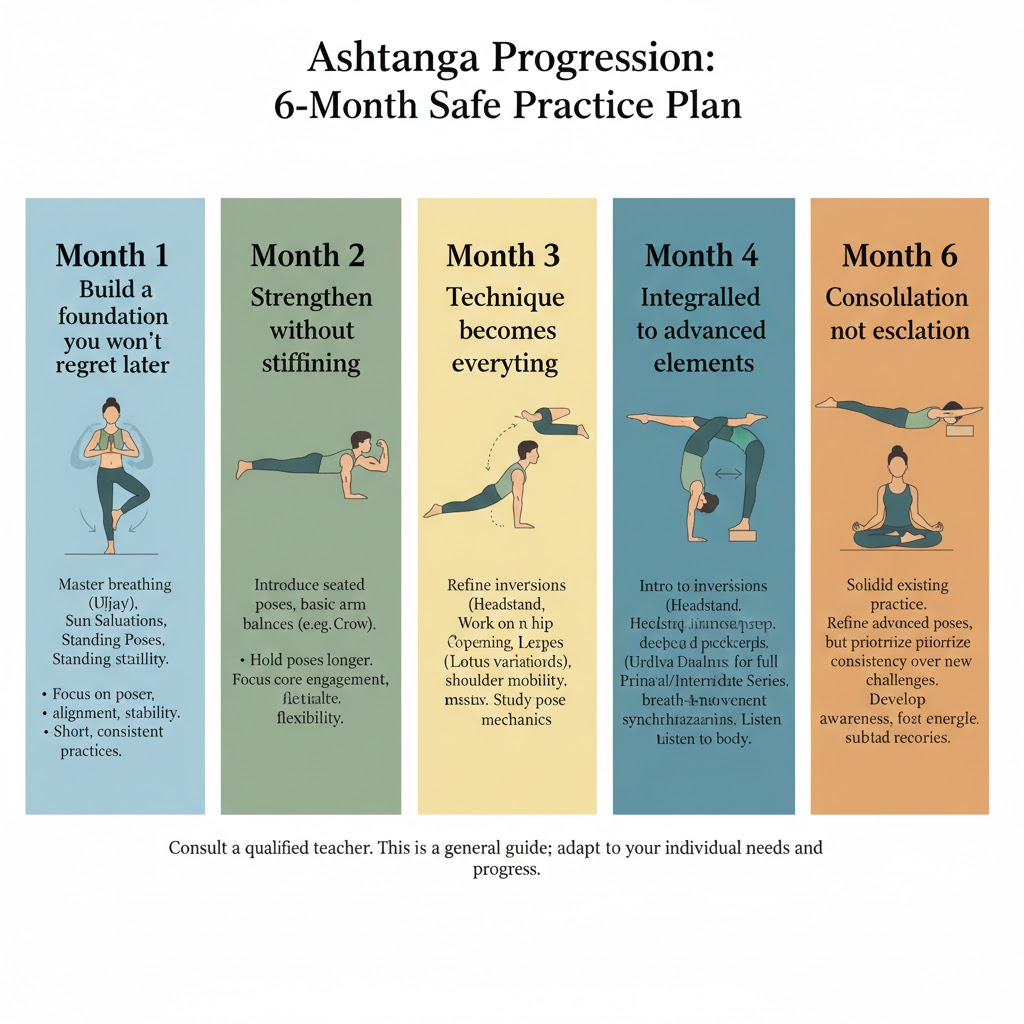
Month 1: Build a foundation you won’t regret later
The first month is unglamorous. And that’s why it matters.
Your only goal here is reliability.
What to focus on
- Breath consistency under mild effort
- Clean alignment in familiar poses
- Daily joint preparation (hips, shoulders, spine)
This is where many people get bored and skip ahead. Don’t. Advanced practice exposes weaknesses it doesn’t create them. Month one is where you quietly reinforce the structure.
What practice looks like
- 4–5 shorter sessions per week (30–60 minutes)
- Slow sun salutations with attention, not momentum
- Core stability work that feels almost too basic
If you leave practice feeling like you could’ve done more, you’re doing it right.
Month 2: Strengthen without stiffening
Now we add intelligently.
This month is about strength that supports mobility, not replaces it.
What changes
- Longer holds in foundational poses
- More shoulder and hip stability work
- Controlled exposure to fatigue
This is where the practice starts to feel athletic. You may notice your breath becoming choppier. That’s data, not failure.
Key mindset shift
Strength isn’t about conquering poses.
It’s about making effort feel quieter.
If your jaw clenches or your breath locks, you’ve gone too far.
Month 3: Technique becomes everything
Here’s where many people plateau or break through.
Month three is about how you move, not how much you do.
What to emphasize
- Transitions (especially between familiar poses)
- Entry and exit mechanics
- Reducing unnecessary tension
You’ll likely work on pieces of advanced poses rather than full expressions. Half-lifts. Supported versions. Wall-assisted work.
This can feel anticlimactic. It’s also where your future self thanks you.
Month 4: Controlled exposure to advanced elements
This is the month people think they want to start with.
You’ll begin touching advanced posesbut briefly, intentionally, and with support.
How to approach it
- Choose 2–3 advanced elements only
- Attempt them after thorough preparation
- Limit attempts (quality over repetition)
Think of this like tasting a dish, not devouring it. You’re learning the flavor, not living there yet.
Emotionally, this month can be intense. Excitement, frustration, comparison all show up. Notice them. Don’t negotiate with them.
Month 5: Integration and endurance
Now things start to click.
Strength, breath, and technique begin to cooperate instead of compete.
What practice feels like
- Longer, smoother sequences
- Fewer dramatic peaks, more quiet control
- Better recovery between sessions
Advanced work stops feeling like a “special event” and starts feeling… normal. That’s a good sign.
You’ll also learn an important lesson here: endurance isn’t about pushing harder it’s about leaking less energy.
Month 6: Consolidation, not escalation
This is where many people make a mistake.
Instead of adding more, month six is about owning what you’ve built.
Focus areas
- Refining what already works
- Assessing readiness honestly
- Building a sustainable long-term rhythm
You might practice something that looks advanced less often now. That’s not regression. That’s maturity.
Ask yourself:
- Can I recover well?
- Is my breath steady under stress?
- Do I enjoy practice more than six months ago?
Those answers matter more than new poses.
Recovery: the invisible half of progress
Let’s be clearadvanced practice is impossible without recovery.
Sleep. Nutrition. Rest days. Gentle movement.
These aren’t optional extras. They’re part of the practice.
If your sleep quality drops or motivation disappears, scale back. Progress happens during recovery, not during strain.
Think of recovery as the soil. You can’t grow anything meaningful in depleted ground.
Common mistakes that slow or stop progress
A few patterns show up again and again:
- Chasing poses instead of mastering preparation
- Ignoring early warning signs in joints
- Comparing timelines with other practitioners
- Treating rest as laziness
If you catch yourself doing these, good. Awareness is the first correction.
How to know you’re actually progressing
Here’s a quiet truth: real progress often feels boring.
Signs you’re on the right track:
- Fewer injuries, not more
- More consistency, less drama
- Greater emotional steadiness during practice
- Faster recovery after challenging sessions
Advanced practice isn’t louder. It’s calmer.
Final thoughts
Progressing from primary to advanced isn’t about proving anything. It’s about capacityphysical, mental, and emotional.
Six months won’t make you “finished.” It will make you prepared. And preparation is what allows advanced practice to become a companion rather than a threat.
Move slowly enough to listen.
Train smart enough to last.
And remember if the practice is still inviting you back tomorrow, you’re doing it right.
FAQs
1. Can I really progress in six months without injury?
Yes, if you respect recovery, avoid rushing, and focus on preparation over performance.
2. How many days a week should I practice?
Four to six days is ideal, with at least one lighter or restorative day.
3. What if I miss a week due to travel or illness?
Nothing breaks. Resume gently. Consistency is long-term, not weekly perfection.
4. Do I need a teacher for this plan?
It helps enormously, but mindful self-practice with occasional feedback can still work.
5. How do I know when I’m “ready” for advanced poses?
When effort feels quieter, breath stays steady, and recovery is easy that’s your cue.