
If you’ve spent any time around Indian philosophy or yoga spacesyou’ve probably heard this debate floating around quietly in the background: Sankhya or Vedanta? Dualism or non-dualism? Separation or oneness?
At first, it can feel like you’re being asked to pick a side. As if philosophy were a sports team. But the deeper you go, the clearer it becomes: Sankhya Darshan and Vedanta aren’t enemies. They’re more like two lenses. Look through one, then the other, and the picture sharpens.
I didn’t understand this early on. I remember reading Sankhya and feeling relieved by its clean logic. Then I encountered Vedanta and felt… unsettled. Too abstract. Too cosmic. It took time and practice for me to realize they were speaking to different stages of understanding, not contradicting each other.
Let’s unpack that.
A shared starting point, very different moods
Both Sankhya Darshan and Vedanta arise from the same broad philosophical soil. They care about suffering. They care about freedom. And they both insist that ignorance not the world itself is the root of bondage.
But their tone is different.
Sankhya feels like a careful engineer. It breaks reality down into components. It wants clarity, classification, clean distinctions.
Vedanta feels more like a poet-philosopher. It dissolves boundaries. It asks you to look again at what you think separation even means.
Same destination. Different roads.
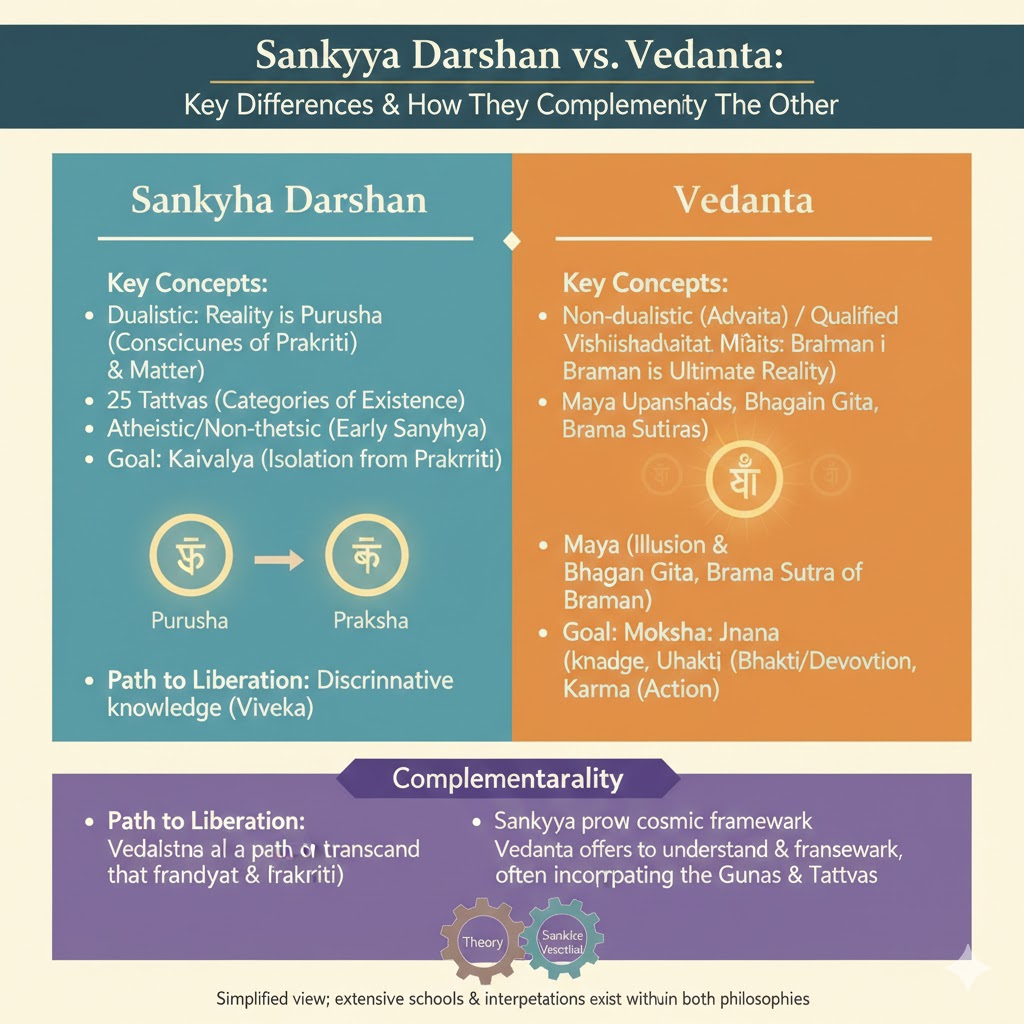
How Sankhya Darshan sees reality
Sankhya starts with two fundamental realities:
- Purusha – pure consciousness, the witness
- Prakriti – nature, mind, matter, change
They are distinct. Always have been. Always will be.
This distinction is Sankhya’s backbone. According to Sankhya, suffering happens because purusha mistakenly identifies with prakriti thoughts, emotions, body, personality. Liberation comes when this confusion ends.
It’s almost therapeutic in approach. Observe. Differentiate. Disentangle.
If you’ve ever sat in meditation and thought, “Oh… I’m noticing the thought, not trapped inside it,” you’ve tasted Sankhya insight.
How Vedanta sees reality
Vedanta flips the script.
Instead of two ultimate realities, Vedanta insists on one: Brahman. Pure, infinite consciousness. Everything elsemind, matter, individuality is a manifestation of that one reality.
From a Vedantic view, separation itself is the illusion.
You are not consciousness watching the world.
You are the consciousness appearing as the world.
That can sound dizzying at first. And honestly, it should. Vedanta isn’t meant to be grasped intellectually alone. It often lands after the mind has been softened by inquiry, discipline, or devotion.
The core difference in one sentence
If I had to compress it brutally:
- Sankhya says: “You are not the mind or bodyobserve them.”
- Vedanta says: “The mind and body are not separate from you.”
One builds freedom through distinction.
The other through dissolution.
Dualism vs non-dualism (and why it’s not a cage match)
Sankhya is classically dualistic. Consciousness and matter are eternally distinct.
Vedantaespecially Advaita Vedanta is non-dual. There is only one reality appearing as many.
But here’s the part that’s often missed: these are not competing scientific theories. They’re pedagogical tools.
Dualism is incredibly useful when the ego is strong and identification is tight. Non-dualism can be destabilizing or by passing if introduced too early.
In practice, many people need Sankhya before Vedanta makes any sense.
How each explains suffering
Sankhya’s explanation is precise:
- The mind suffers because it thinks it is the self.
- Liberation comes from discriminating awareness from activity.
Vedanta goes deeper:
- Suffering arises because we forget our true nature as whole and complete.
- Liberation comes from remembering what was never lost.
Sankhya treats suffering like a case of mistaken identity.
Vedanta treats it like amnesia.
Both are compassionate diagnoses. Just at different depths.
Knowledge vs knowledge (subtle but important)
This is where the philosophies really diverge in flavor.
In Sankhya, knowledge is discriminative. You learn to tell things apart: witness vs witnessed, permanent vs impermanent.
In Vedanta, knowledge is revelatory. It’s not about adding information, but removing false assumptions until truth stands alone.
Sankhya sharpens the knife.
Vedanta asks you to drop it.
Why yoga historically leans on Sankhya
Classical yoga philosophy borrows heavily from Sankhya for a reason.
Yoga is a method. Sankhya provides a map.
Ideas like:
- Purusha and prakriti
- The gunas
- The evolution of mind
These give yogic practice structure. They help practitioners understand what is changing and what is not. Without that clarity, meditation can turn vague very quickly.
Sankhya grounds practice. Vedanta crowns it.
How they actually complement each other
Here’s the part that changed everything for me.
Sankhya helps you untangle.
Vedanta helps you transcend.
In lived practice, it often looks like this:
- Sankhya trains you to witness thoughts, emotions, sensations.
- Identification loosens. Space appears.
- Vedanta steps in and asks, “Who is witnessing?”
- Even the sense of separation dissolves.
You don’t skip steps. You grow through them.
Trying to jump straight to non-duality without discernment often leads to confusion or spiritual bypassing. Staying stuck in analysis forever can lead to dryness or detachment. Together, they balance each other beautifully.
Which one should you follow?
Honestly? Probably both just not at the same time, and not in the same way.
If your mind is busy, reactive, and tangled:
- Sankhya will feel like relief.
- Clear categories. Clear boundaries. Breathing room.
If your mind is already calm and spacious:
- Vedanta may resonate more deeply.
- It speaks to unity rather than management.
Philosophy isn’t about loyalty. It’s about usefulness.
A simple daily-life example
Imagine watching waves in the ocean.
Sankhya says:
“You are the observer watching the waves rise and fall.”
Vedanta says:
“You are the ocean appearing as waves.”
Neither is wrong.
But you don’t appreciate the ocean fully until you’ve stopped being knocked over by every wave.
Final thoughts
Sankhya Darshan and Vedanta are not rivals. They’re stages of seeing.
One teaches clarity through separation.
The other teaches freedom through unity.
Together, they offer something rare: a philosophy that respects both the mind’s need for structure and the heart’s longing for wholeness.
If you let them work together patiently, honestly they don’t confuse the path. They illuminate it.