
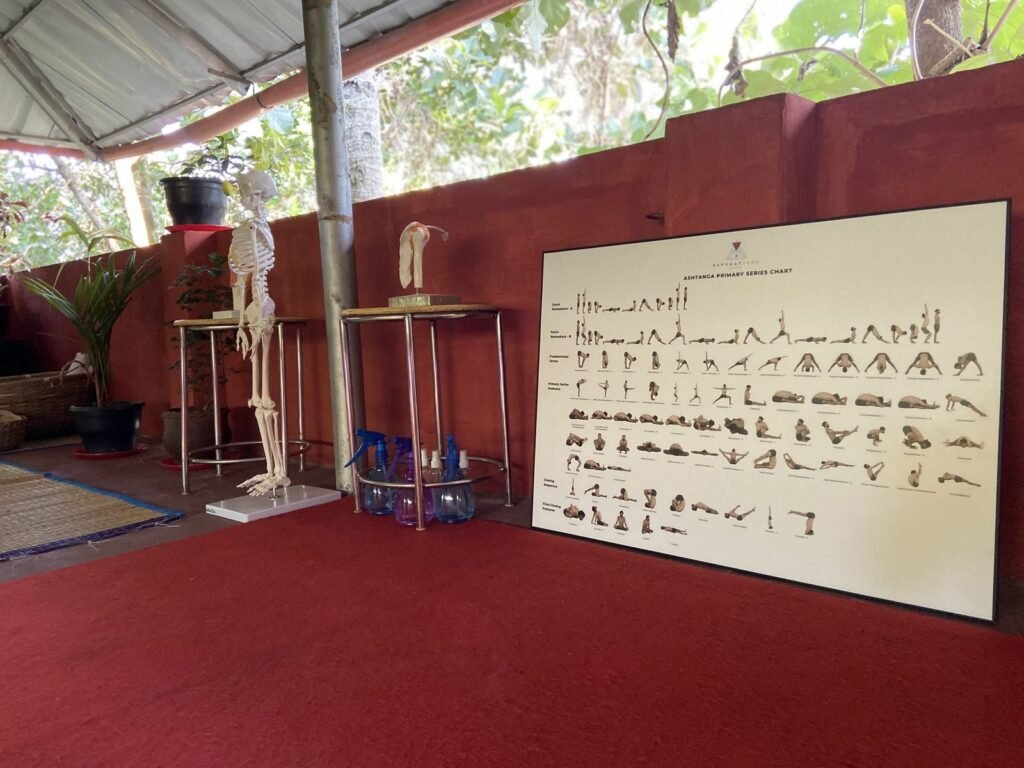
Bandhas are crucial to Ashtanga Yoga’s effectiveness as a practice. The use of Ashtanga Yoga offers additional benefits compared to their use in other fitness regimens. Bandhas in conjunction with Ashtanga Yoga fortify your body while providing the cleansing and purifying benefits of improved circulation throughout your body, in addition to the benefits derived from a meditation practice.
Bandhas are natural ”energy locks” and, in relation to Ashtanga practice, the secret to Arm Balances. Bandhas are used to stabilize the body in an arm balance pose and, due to your pelvis’s body core and Bandhas creating warmth and energy from the practice, Bandha’s provide lightness to allow an easier, flowing movement from once pose to the next.
What Are Bandhas?
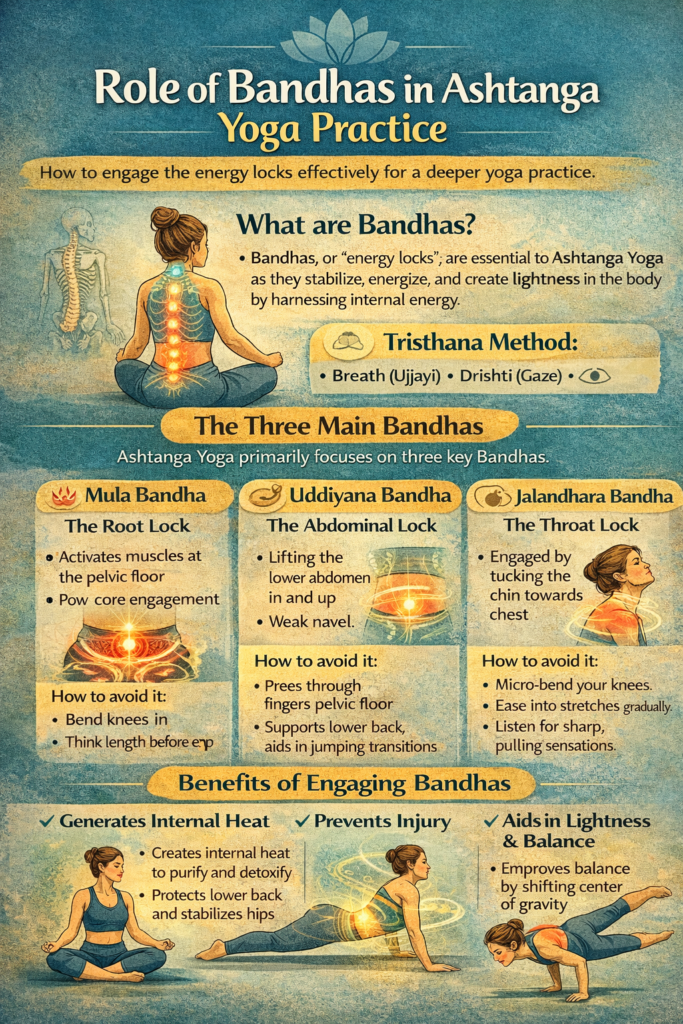
In Sanskrit, the word Bandha means to lock, hold, or tighten, and relates to the practice of Bandhas and the construction of a few core muscle. Physically Bandhas tighten in a lesser, more restrictive manner than the closure of a valve while spiritually Bandhas releases and and alter the circulation of Prana, or lifeforce, throughout the body.
Tristhana method includes Breath (Ujjayi), Bandhas, and Drishti (Gaze) as a three-point focus of Ashtanga. Of the three, Breath and Drishti regulate and provide focus while Bandhas provide and maintain structural and energetic integrity.
Three Primary Bandhas
Of the many Bandhas or valves described in Hatha Yoga, Ashtanga focuses on Meditation Bandhas as its essence practice: Mula Bandha, Uddiyana Bandha, and Jalandhara Bandha.
1. Мula Bandha (The root lock)
The first lock is at the root or pelvic floor. This is the contraction of the anal and genital regions in men. In women, it is the contraction of the muscles at the bottom of the pelvic floor and the cervix.
The Function: Mula Bandha is the lock of the foundation of the spine. By engaging these muscles, we keep the energy contained at the bottom of the body and direct it upward.
In a Practice: It is less about a hard squeeze and more about a gentle lift. It gives a sense of “groundedness” and stability and is especially useful during standing postures.
2. Uddiyana Bandha (The Abdominal Lock)
The translation of Uddiyana is “flying upward.” In the realm of daily asana practice, this is a “soft” version of a complete abdominal retraction as in Kriyas. This involves drawing in and upward of the lower belly, about three inches below the navel, towards the spine.
The Function: This bandha is meant to give lower back support and protect the lower back. The lower belly can create a hollow space that allows you to perform the “jump-throughs” and “jump-backs” that are hallmark ashtanga transitions.
The Synergy: The combination of Mula Bandha and Uddiyana Bandha together creates an airtight compartment in the torso that makes the body feel extraordinarily light, and that’s how the levitation effect is achieved during vinyasas.
3. Jalandhara Bandha (The Throat Lock)
Jalandhara is used mostly during seated Pranayama (breathing exercises), and during some specific poses such as Sarvangasana (Shoulder Stand). Jalandhara Bandha is completed by creating length behind the neck and tucking the chin in toward the chest.
Function: This bandha manages the concentration of prana to the brain and blood pressure during retention of the breath. Practiced in the Ashtanga flow, it’s not primarily focused as a physical “lock”, but more of a gentle adjustment of the cervical spine to allow unimpeded flow of prana from the root to the crown.
Understanding the Role of Bandhas in the Practice
So what is the excitement about bandhas, and what are the implications of these being practiced during a typical 90-minute session in a Mysore style class?
1. Generation of Internal Heat (Agni)
The main objective in Ashtanga is the achieve a pure state through the process of sweating – a lot. Bandhas effectively constrict energy like a bellows to a fire. By locking energy at the base (Mula) and at the middle (Uddiyana), we concentrate the internal fire (Agni) in the torso. This fire helps to thin the blood and flush out toxins from the muscles and organs.
2. Prevention of Injuries
The large majority of injury in yoga happens as a result of “dumping” weight into the joints (especially when we are tired) or extending the spine too far (over-extending).
Uddiyana Bandha protects the lumbar spine by creating a natural “weight-lifting belt” out of your own musculature.
Mula Bandha ensures that the hips are stable and prevents sacroiliac (SI) joint issues.
3. The Buoyancy Factor
Ashtanga practitioners master the art of floating. The Bandhas allow practitioners to transcend gravity or the practitioner may be skilled at jumping. Practitioners shift their center of gravity to make bodyweight resistance feel like nothing.
”Bandhas are the secret to lightness. Without them, the body is heavy and the mind is dull.”
How to Integrate Bandhas into Your Practice
As a beginner, Bandhas may feel complicated. It is possible to engage your abs and feel your pelvic floor. Here’s a guide to help with that:
Step 1 – Start with the Breath
Ujjayi Pranayama is the breath technique of choice to master Bandhas. The throat and lung technique (holding at the back) makes it easier to access the lower abs. An important exhale to master is one that has pelvic floor lift, which corresponds to Mula Bandha, during the exhalation.
Step 2: The 20% Rule
The Bandhas should be held at 20% engagement to implement this technique into practice. This should help avoid shalow, breath and tension associated with full, thirty percent or more engagement. It should even feel like a good background hum (i.e. hit and pal). You should be able to take a full ribcage breath even with Bandhas.
Step 3: Using The Transitions
The best time to “find” your Bandhas is during the vinyasa. When you inhale to lift or exhale to jump, consciously draw the navel in. Over time, this will become muscle memory.
The Energetic Perspective: Beyond the Physical
In the yogic tradition, the body is crisscrossed by thousands of energy pathways called Nadis. The most important is the Sushumna Nadi, which runs through the spine.
The Bandhas are made to push Prana into this central channel. Usually, energy is lost from the body through the senses and the reactivity of the mind. By securing the “doors” of the body, we turn that energy inwards and upwards. This is the reason a committed Ashtanga practice leads to better mental clarity and a feeling of heightened awareness which is an energetic upgrade.
Conclusion: The Quiet Strength
The Bandhas in Ashtanga Yoga are an entry point into the physical practice and the spiritual. While muscles may tire, and flexibility may be better or worse, Bandhas give a consistent internal focus point.
Strength is often perceived to be from large and visible muscles but that is an incomplete definition. The most powerful transformations often come from the deep and quiet “locks” that are hidden. When you step onto your mat tomorrow, shift the focus from how deep you can go into a fold to how high you can lift from the bottom. That is where the real yoga begins.