
I still remember the first time I felt my hamstring pull during a forward fold. Not very dramatic. No loud snap. No fall. Just a quiet “that doesn’t feel right.”, I like most people, finished the session and felt proud of pushing through. The next morning was a completely different story.
That’s the tricky part about yoga injuries: they don’t always show up immediately. More often, they don’t come from extreme movements, but from doing something slightly wrong repeatedly.
Yoga supposed to heal. So how do people get injured? Let’s talk about that.
The uncomfortable truth about yoga injuries
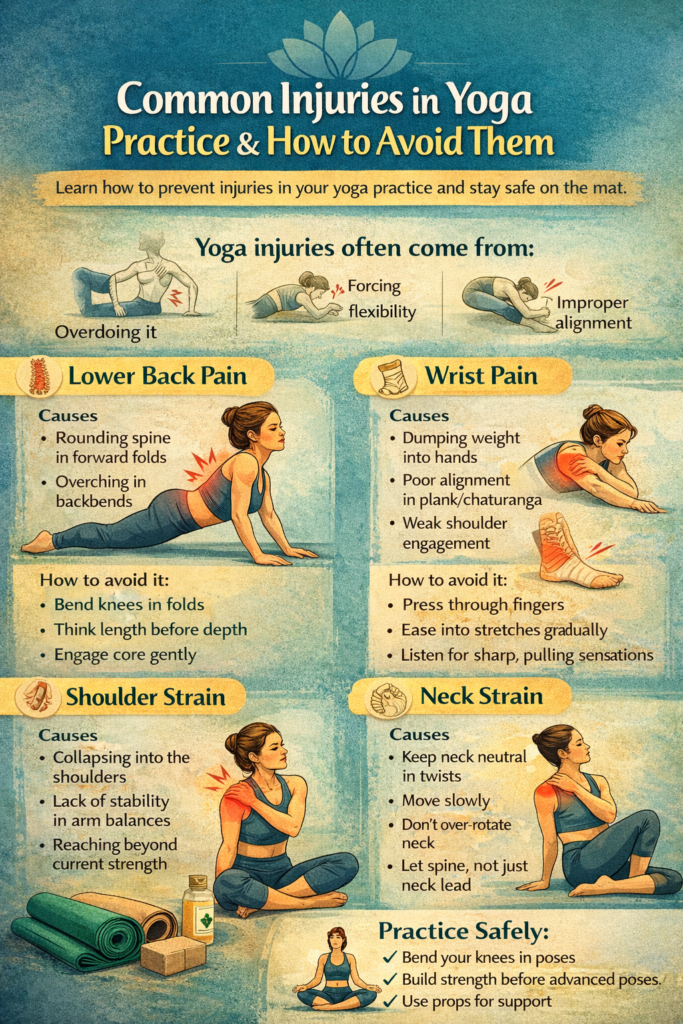
Most yoga injuries don’t come from the pose itself. They come from doing too much too soon, forcing flexibility, ignoring alignment, not listening, and not knowing where a limit is.
Yoga doesn’t always feel like “strain.” It feels like stretch. And that line between a good stretch and a bad one is thinner than most people think.
The most common yoga injuries – Lower back pain
This one shows up a lot, especially in forward folds and backbends.
You bend forward, trying to touch your toes. Maybe you round your back a bit to get there. It feels like progress. But over time, that rounding starts putting pressure where it shouldn’t.
Or in backbends when you push too deep, compress the lower spine, and it feels fine in the moment.
Your body is much smarter than you think.
It usually responds poorly to the following things:
- Hunching of the spine with no hip hinge
- Arching of the back in backbends
- Insufficient core engagement
You can avoid this type of stress by doing the following:
- Ensure you bend your knees in all folds, even if no one else is doing the same.
- Prepare to think more about the length than the depth of the pose.
- Sustain a gentle engagement of the core but don’t brace it hard, just enough to provide some support.
Sometimes your range is even less, and that could provide you more safety.
Wrist Weakness (most notably in Ashtanga and vinyasa).
If you’ve done a few Sun Salutations with arches and backbends, you’ve probably heard friends complain about wrist pain—and it’s something many of us experience.
Wrist pain is aggravated by the following:
- Chaturangas
- Planks
- Downward dogs
- All pose variations load the wrists and can aggravate wrist issues easily
- Uneven distribution of weight
Hamstring Injuries (The Sneaky Kind)
Hamstring injuries are amongst the sneakiest injuries.
During a pose, they’re rarely felt in the moment, which makes them especially deceptive. Instead of appearing suddenly, they tend to build gradually over time.
In any form of stretching, it’s easy to go too far. For those who are already flexible, the risk often lies in pushing into extreme ranges without enough awareness or control.
The causes of hamstring injuries are easy to identify:
- Over stretching/pulling
- Locking the knees
- Forcing depth
Avoid it by the following means:
- Micro-bending your knees a good bit means you will be less likely to incur injuries.
- Gradual stretching is the key to desired improvements.
- Sharp, pulling sensations should be paid attention to and a good stretch should feel more…steady.
Shoulder Strain (Often Ignored)
Shoulder strain is one of the most common yet overlooked issues in yoga. Because it often builds gradually, it can go unnoticed—until discomfort or injury appears.
Your shoulders are involved in almost everything: planks, arm balances, and inversions. They are incredibly mobile, allowing for a wide range of movement, but this same mobility also makes them more vulnerable to strain when strength and stability are lacking.
What causes it?
- Collapsing into the shoulders
- Not active enough in an arm balance
- Reaching beyond current strength
How to avoid it:
- Build strength first before outwards poses
- Keep shoulders active and not passive
- Don’t rush in to an inversion
If your shoulders are unstable, your practice will be too.
Neck Strain (usually from small mistakes)
Neck strain often comes from movements that feel completely harmless—small adjustments you barely notice in the moment.
Looking around in a twist, dropping the head back in a backbend, or turning the neck just a little too far can all add unnecessary strain. Because the neck is so mobile and sensitive, even minor misalignment can build up over time..
What causes it?
- The over-rotation of the neck
- Lack of awareness
- Visual completion of a pose
How to avoid it:
- Keep the neck neutral
- Don’t rush the movement
- The movement should come from the spine, not just the neck
The real source of injury
We often focus on the physical aspect, but the life also has an emotional aspect. This comes from:
- Mental comparison to others
- Trying to keep up in class
- Progressing too quickly
- Just wanting to feel like your “doing it right” That is often where it goes wrong.
Yoga is not about reaching the pose; it is about your practice getting to that pose.
A small change that can make the difference
Instead of asking, “How deep can I go?” Ask “How does this feel?”
This question can change your practice completely. You begin to notice…
- Having a lot of muscle tension.
- Having body aches.
- Having soreness throughout your body.
Then, you begin to refine the way you view your body. The goal is to work with your body, not push your body.
Safe practices may not look the best
Safe practices may not look the best and may not be the most impressive, Safe practices may include:
- Bending your knees
- Adjusting your body to release your pose
- Taking breaks
And that’s okay. Safe practices is what allows long-term practice.
Final thought
Most yoga injuries can be prevented by not being perfect. It’s about body awareness.
Your body is sending signals all of the time, and the more you listen the more your practice shifts into understanding instead of just pushing.
This is the true essence of yoga.