
Indian philosophy doesn’t hand you neat answers wrapped in bullet points. It hands you mirrors. Two of the sharpest mirrors it ever produced are Sankhya and Vedanta. Both try to solve the same riddle — what am I, really? — but they walk in almost opposite directions to reach it.
One is a map of the universe in 25 tidy boxes.
The other is a relentless insistence that there is only one thing, and it isn’t any of the boxes.
Let’s sit with both. Slowly. No exam hall mindset.
Where Sankhya Begins: Count Everything
Sankhya literally means number or enumeration. Its genius is simple: if you want freedom from suffering, first understand the machinery of experience.
Sankhya doesn’t argue emotionally. It catalogs reality.
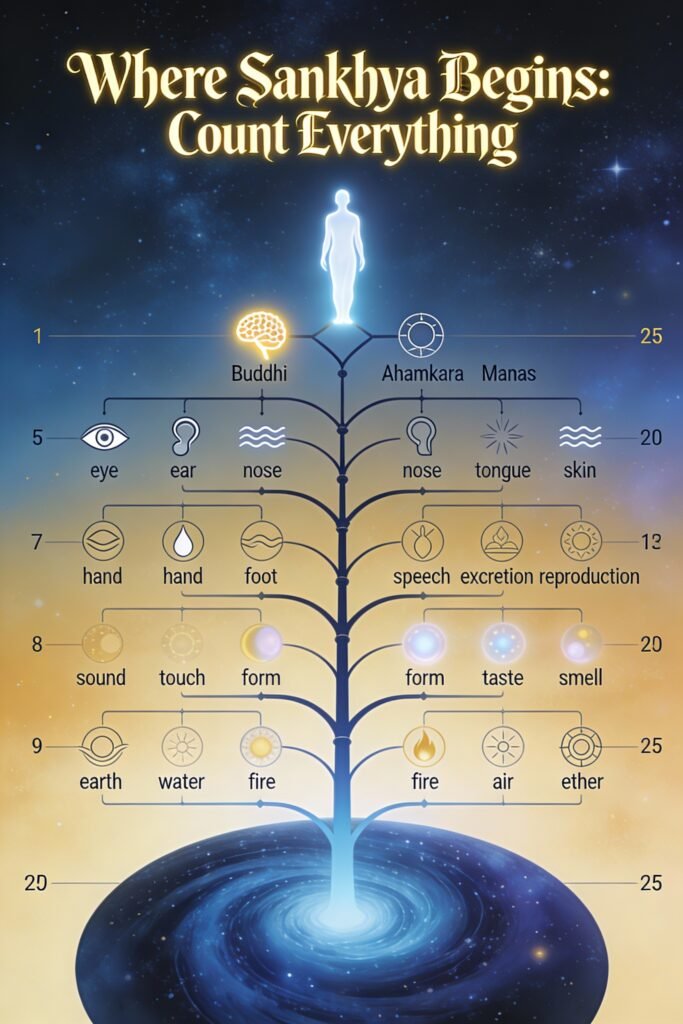
According to classical Sankhya, existence unfolds through 25 tattvas — fundamental principles.
At the top are two eternal realities:
- Purusha – pure consciousness, the witness
- Prakriti – primordial nature, the engine of creation
Everything else is born when Prakriti evolves under the silent gaze of Purusha.
From Prakriti arise:
- Buddhi (intellect)
- Ahamkara (ego-sense)
- Manas (mind)
- Five sense organs
- Five action organs
- Five subtle elements
- Five gross elements
That’s the world you walk around in. Not poetry — mechanics.
The Big Sankhya Claim
You suffer because you confuse yourself with the machinery.
Purusha is not sad.
Prakriti is not trapped.
But when the witness forgets it is the witness, liberation turns into laundry, taxes, anxiety, and back pain.
Freedom in Sankhya comes from discrimination — clearly seeing what is Purusha and what is Prakriti. Nothing mystical. Just relentless clarity.
Where Vedanta Begins: Undo Everything
Vedanta is not interested in counting your furniture. It asks a more uncomfortable question.
Who is the one counting?
Vedanta begins where Sankhya stops — at the level of identity itself.
Vedanta is based on the Upanishads, and their central thunderbolt is this:
Atman (your true Self) is Brahman (the absolute reality).
Not similar.
Not part of.
Identical.
Everything you think you are — name, role, memory, ambition — is temporary clothing worn by consciousness. Vedanta’s goal is not to separate consciousness from matter, but to dissolve the illusion that matter was ever independent in the first place.
Dualism vs Non-Dualism
This is the fault line.
| Sankhya | Vedanta |
|---|---|
| Reality is dual: Purusha and Prakriti are eternally separate | Reality is non-dual: only Brahman exists |
| The world is real | The world is relatively real (Maya) |
| Liberation is discrimination | Liberation is realization |
| You are the witness of nature | You are everything |
Sankhya says: I am not the body, I am the seer.
Vedanta says: There is no body separate from me at all.
One sharpens the knife. The other melts it.
How They Explain Suffering
Sankhya’s Diagnosis
Suffering exists because Purusha identifies with Prakriti’s modifications.
Mind restless?
That’s Prakriti.
Ego offended?
Also Prakriti.
Purusha is untouched — but it forgets that.
The cure is to observe experience until identification falls apart. Think of it as spiritual physiotherapy.
Vedanta’s Diagnosis
Vedanta goes deeper.
There is no “witness stuck in the world.”
There is only Brahman appearing as world.
Suffering is not caused by entanglement — it is caused by ignorance of non-duality. You don’t suffer because you are in the movie. You suffer because you think you are one character inside the movie.
The Path of Practice
Sankhya is analytical. Vedanta is existential.
Sankhya Practice
- Discrimination between seer and seen
- Deep study of tattvas
- Meditative observation of nature’s processes
- Detachment through insight
The mind becomes a microscope.
Vedanta Practice
- Self-inquiry (Who am I?)
- Study of Upanishads, Bhagavad Gita, Brahma Sutras
- Contemplation of Mahavakyas like “Tat Tvam Asi”
- Dissolving the sense of separateness
The mind becomes a mirror — and then shatters.
Their Relationship with Yoga
Here’s the irony. Most people practice yoga rooted in Sankhya metaphysics while talking about Vedantic oneness.
Patanjali’s Yoga Sutras are built on Sankhya:
- Seer (Purusha)
- Seen (Prakriti)
- Liberation through discrimination
Yet modern yoga studios quote Vedantic slogans about universal oneness.
They are different systems. Beautifully different.
God: Optional or Everything?
Sankhya is famously non-theistic. It doesn’t deny God; it simply doesn’t need one.
The universe runs on the dynamics of Prakriti and the silent witnessing of Purusha.
Vedanta, on the other hand, swallows God whole.
Not a deity in the sky.
God as existence itself.
You don’t worship Brahman.
You wake up as Brahman.
Freedom: Escape or Embrace?
Sankhya is liberation through separation.
Vedanta is liberation through inclusion.
Sankhya frees you from the world.
Vedanta frees you as the world.
That is why Sankhya feels clean, surgical, almost scientific. Vedanta feels dangerous — because it doesn’t leave anything outside the door.
Which One Is Right?
That question is like asking whether anatomy is truer than poetry.
Sankhya teaches you how the prison is built.
Vedanta reveals that there was never a prison at all.
Most seekers unconsciously walk both paths. They begin with Sankhya-like clarity — sorting mind from matter — and mature into Vedantic seeing, where the sorting itself dissolves.
Closing Reflection
Sankhya hands you a blueprint of existence.
Vedanta sets fire to the blueprint.
One gives you freedom by knowledge.
The other gives you freedom by identity.
And somewhere between counting the pieces and dissolving the count, the seeker quietly disappears — leaving only awareness, wondering how it ever thought it was anything else.