

Yoga often begins with physical movement – Stretching, deep breathing, and holding different poses. With a regular practice, you will begin to uncover a deeper inquiry – Who is the one experiencing all of this? This is the crux of yoga. This inquiry leads to the most critical aspect of Sankhya philosophy – It is the basis of all philosophy. It is the beginning of a deeper practice.
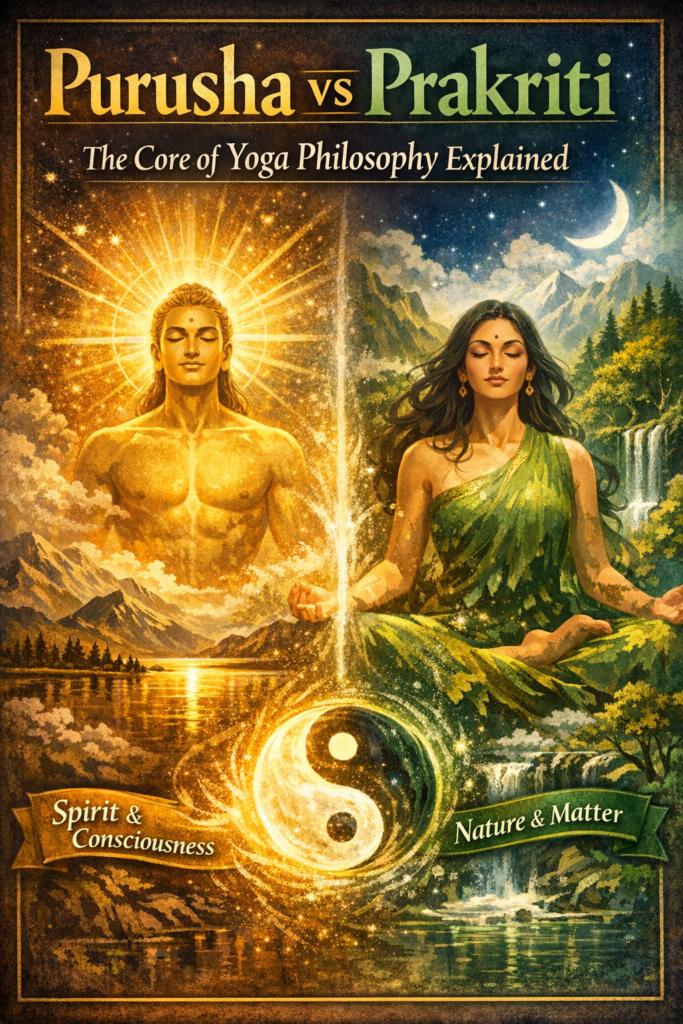
What is Purusha?
Purusha is the witness. Purusha is an unchanging, unmoving, non-reacting awareness. Purusha is the witness to, your body, your thoughts, your emotions, and everything else you might call yourself.
What is Prakriti?
Prakriti is everything that is in a state of movement. This includes everything. Your thoughts and emotions and your physical body, and your mental body, and your senses, all are Prakriti. It is everything in nature. It is everything that is in a constant state of flux.
This is the source of suffering.
When we confuse Purusha with Prakriti, that is the beginning of suffering. When you say – I am tired. I am anxious. I am depressed. You are identifying with an aspect of yourself that is in constant state of flux. You are identifying with Prakriti. What is actually true is the opposite. Anxiousness is occurring, Depletion is occurring, and a thought stream is occurring. And you are the awareness of all of this.
This is a shift in perception.
How yoga applies this idea
Yoga’s purpose is to remove the direct connection between the observer and the experience.
Every piece of yoga is designed to aid this.
In asana (postures)
You hold a pose. Sensations arise.
You do not respond, you observe.
You stop saying, “This is uncomfortable.”
You start noticing, “Sensation is present.”
That’s the first movement in that direction.
In breath (pranayama)
Breath becomes a tool to bind or calm the mind.
As breath begins to slow, the mind settles.
Once the mind is settled, awareness is more pronounced.
Instead of being lost in the mind, you are now observing it.
In meditation.
Here is where the distinction becomes direct.
You sit. Thoughts come.
You do not engage. You do not suppress. You do not focus. You simply watch.
That watcher is Purusha.
Here is a simple real-life analogy
Let’s say you are stuck in a traffic jam.
Normally:
- You feel irritated
- You react
- You mentally become stressed
Now apply this understanding:
- Irritation is happening
- Thoughts are reacting
- And you are observing all of it
The situation hasn’t changed.
But your experience has.
This is practical yoga.
Why this matters in modern practice
A lot of people think that doing yoga is practicing fitness. That’s completely fine, but it’s also completely wrong.
Without this understanding:
- The yoga practice is just a mechanical workflow.
- The mind still has that restlessness.
With this understanding:
And this is where the beauty of yoga practice lies.
Yoga is not about performing. It is about being present.
The three principles in the universe.
Naturally, the world has three operational qualities:
- Tamas (weight, stillness)
- Rajas (movement, activity)
- Sattva (consistency, equilibrium)
Your perception of the world changes among these.
Yoga aims to expand the experience to the level of Sattva.
But Sattva is still part of the world.
Purusha is beyond these three.
The prize is perception unclouded.
Sankhya does not require you to modify the world.
It requires you to perceive.
When you can perceive unclouded:
- What is moving (Prakriti)
- What is unchanging (Purusha)
You cease to grasp.
And liberty begins.
The most common misconception.
Detachment does not mean being disconnected.
It is quite the opposite.
You will still engage.
You will still have thoughts.
You will still experience things to the fullest.
But you will not be constrained under the rule of an emotion, thought, or experience.
You will respond, instead of just reacting.
How to do this every day
You don’t need to read some complicated philosophy to achieve this.
Instead, you can employ this simple method:
- Pay attention to your breath for a minute.
- Watch your thoughts without attaching to them.
- When you describe your experience, say, “Tension is present” instead of “I’m tense.”
For example:
- “Thinking is happening”
- “Tension is present”
- “Breath is moving”
Your discernment will increase.
Final thoughts
Purusha and Prakriti are not philosophical.
They are for you to understand your perception.
Yoga teaches you to distinguish each.
Body will move.
Mind will change.
The life will fluctuate.
Your perception will remain.
And the moment you start staying in your perception, practice stops being a thing you do.
It morphs into a state of being.