
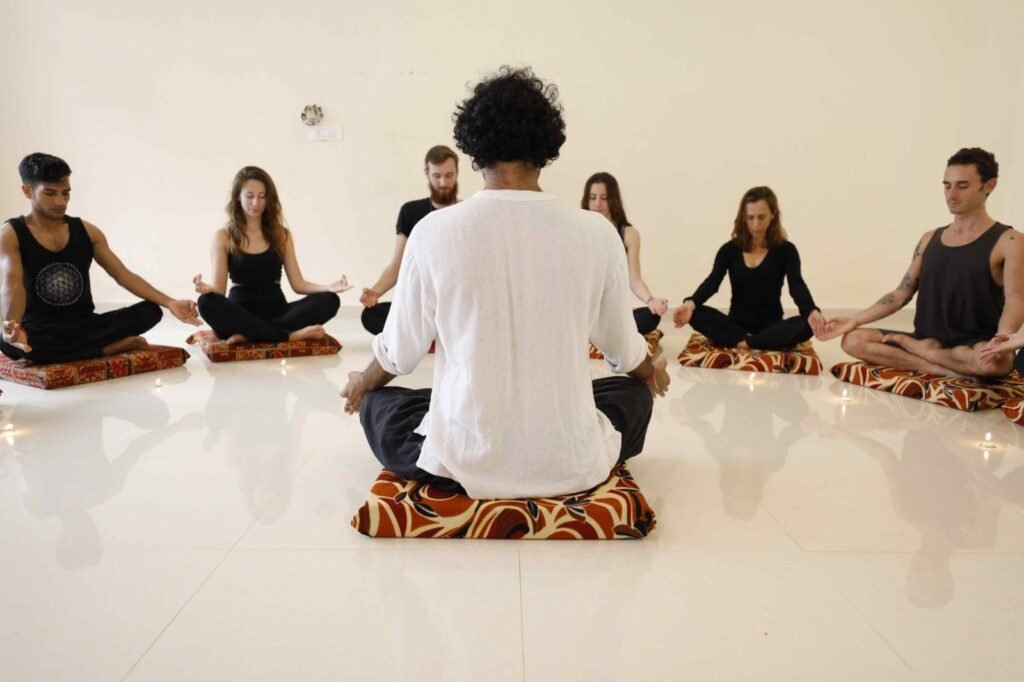
Devvrat Yoga offers a distinct attitude towards a 200-hour Yoga Teacher Training. Everyone defines it as some form of rigid schedule based on the syllabus. Of course, yes, there are long classes, some theory, and a certificate. At Devvrat Yoga, the training set for 28 days with an immersive feature for beginners, regulational level students, small groups, and a guided practice leading to an RYT 200 certification. Training is planned to give Yoga Alliance certification with small group teachings
One of the strengths of the program is its balance. Structure, but not cold. Discipline, but not the mechanical. Daily full scheduling is scattered philosophy, meditation, pranayama, and Ayurveda. Provided an opportunity to Hatha and Ashtanga practice. Unlike an empty schedule, it is a full schedule through repetition and routine to lead formality as education through such a program.
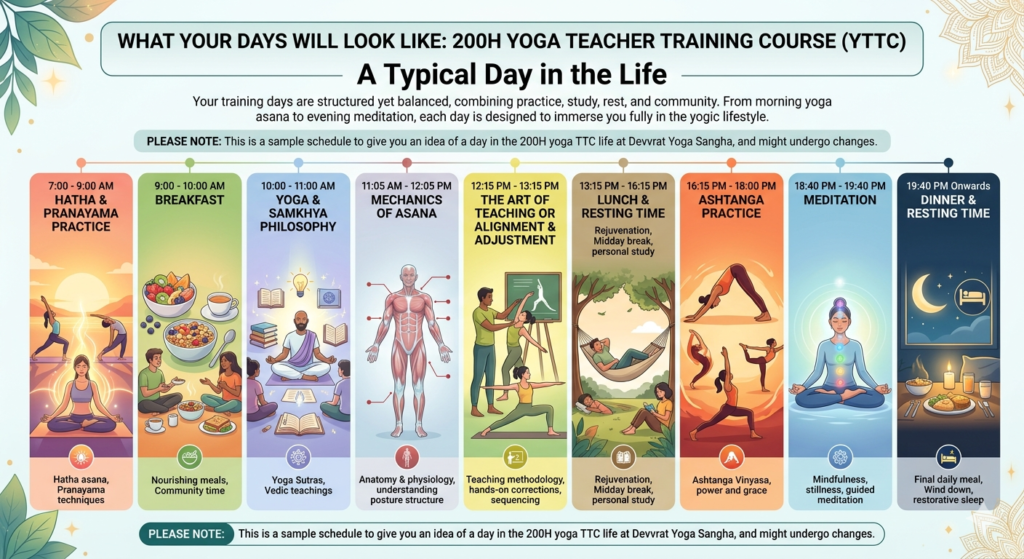
Before we Zoom down Presentation framework
Most of the students follow training to run for 21 days to 28 days: Late practice in the early hours, afternoon study sessions, and evening teachings and teachings. Devvrat Yoga states that the flow may change, but the schedule remains the same: Hatha and pranayama in the morning, Philosophy the mechanics mid morning, Methodology/ Alignment work before lunch, and Ashtanga practice later in the day.
The practice of yoga is meant to introduce you to a different way to live your life, and this is only possible if you understand the importance of the structure of this training. You will come to understand yoga is not a one hour a day practice. It’s a lifestyle in how you move, think, eat, rest and direct your attention.
A Realistic Daily Schedule (What Your Day Actually Looks Like)
This is the breakdown.
6:00 – 7:00 AM | Wake Up & Personal Time
Consider this your quiet hour.
Some people use the time to journal.
Some enjoy the time with a hot cup of chai.
Some, (especially during week 1) contemplate their life choices and wonder why they are up this early on a yoga teacher training day.
You don’t have to rush, but you do have to wake up early and that’s the point.
7:00 – 9:00 AM | Hatha Yoga + Pranayama
This time slot is your foundation.
You start with:
- Joint warm-ups
- Some foundational asanas
- A bit of Breathwork (pranayama)
The focus is on alignment, awareness, and feeling.
Your teacher will:
- Correct your posture
- Slow you down
- Encourage you to feel rather than perform and practice your asanas.
9:00 – 10:00 AM | Breakfast
Your meal is simple, registered as sattvic and clean.
You are not provided heavy foods that are distracting.
Your practice is supported by food that is easy to digest, light provides no energy crash later.
Weirdly, this will something you begin to appreciate.
10:00 – 11:00 AM | Yoga Philosophy
This is where your training starts to deepen.
Some of the topics you will cover include:
- The Yoga Sutras
- Sankhya philosophy
- Yogic lifestyle
- Mind and suffering
It may seem abstract at first, then it will feel personal.
You will begin to make the connections between:
- Your habits
- Your reactions
- Your thoughts
You will find that yoga has moved off the mat.
11:05 AM – 12:05 PM | Anatomy & Mechanics of Asana
Excellent session for learning about the layer beneath the surface.
You learn:
- Joints and muscles.
- Staying safe and learning how to prevent injury.
- Safe alignment.
- Different movement systems.
Clear understanding begins.
You learn to stop guessing.
You learn to start understanding.
12:15 – 1:15 | Teaching Methodology / Alignment
This session changes everything.
You are no longer just a student.
You learn:
- How to guide a class.
- How to adjust students and how to shift instructions to someone else.
At first, it feels quite awkward.
You may forget some of the terms and feel hesitant to say a few,
All of this is part of the learning:
Part of the training.
1:15 – 4:15 PM | Lunch + Rest
This is the most underappreciated session.
You first to feel your body burning out.
Rest is essential, it’s part of training.
Sometimes, for the entire day, you might need just to lie down and do nothing.
4:15 – 6:00 PM | Ashtanga Yoga Practice
This class is the most dynamic of all.
Compared to morning Hatha this is a faster practice.
Stronger physical demand, and operates under a
structured and pre-defined sequence.
Depending on the class, you might experience:
- Guided instruction
- Standard Mysore-style (self-paced)
This class sharpens your self-discipline.
Well, you notice a few changes.
- Your newfound endurance
- Your breath control under pressures
- Your mental toughness
Your body is now feeling good fatigue.
9:00 – 9:30 PM | Wind Down & Sleep
Sleep is sacred now.
Because tomorrow…
you do it all over again.
Weekly Rhythm (It’s Not All Intense)
Not every day is equally intense.
Most schedules include:
- One lighter day or complete rest day in the week
- Cultural activities or beach time (especially in Kerala)
- Workshops or special classes
The core structure is steady.
And that steadiness?
That’s what transforms you.
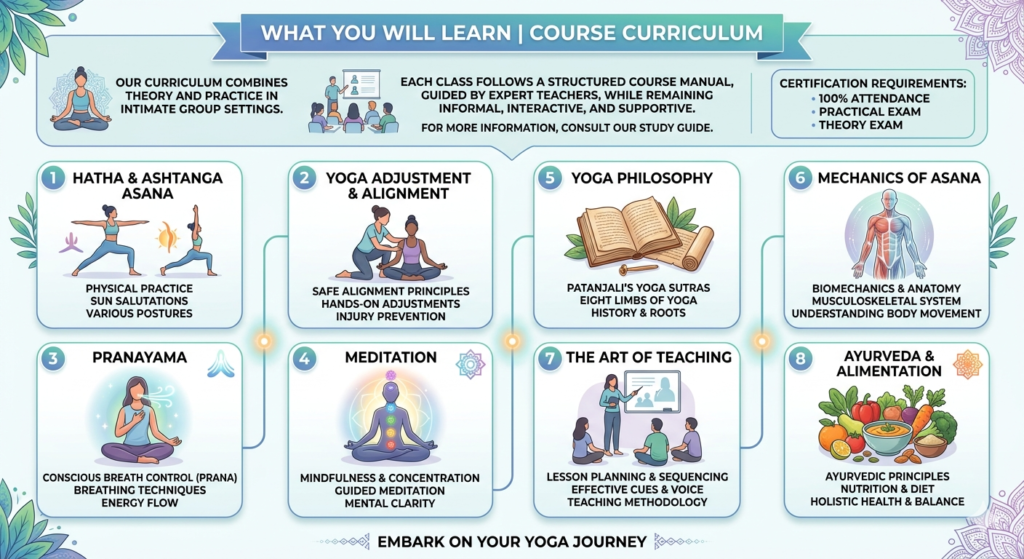
What You Actually Learn (Beyond Poses)
The curriculum covers far more than postures. Students study Hatha and Ashtanga asana, yoga adjustment and alignment, pranayama, meditation, philosophy, the mechanics of asana, teaching methodology, and Ayurveda & alimentation. The course also requires 100% attendance, along with practical and theory exams for certification.
That mix is what makes the training feel complete. You learn how to practice safely, how to understand the body, how to use breath work, how to explain yoga clearly, and how to bring yogic principles into daily life. Devvrat Yoga frames this as a training that builds both personal understanding and the ability to guide others with confidence.
Course Features That Make a Difference
Some people overlook some aspects that matter, but they truly make a difference:
- Small group training: more personal attention
- Hands-on adjustments: real learning
- Course manual + books: structured reference
- Ayurvedic consultation: deeper body understanding
- Community living: shared growth
And it is true that in the end…
the people you connect with become part of the experience.
The Challenges (No One Talks About Enough)
Let’s be real.
You might experience:
- Physical exhaustion
- Mental exhaustion
- Emotional exhaustion
Despite the various challenges, you’ll be tempted to ask yourself the question.
“Did I really sign up for this?”
You are not failing.
That is the process.
A discomforting journey.
What Most People Don’t Expect
The biggest shifts happen on the inside.
You start:
- Noticing the pattern of your thoughts
- Controlling the impulse of your reactions
- Being present in the moment
The best way I can describe this is
Yoga is not an action, it’s a way of being.
Who Is This Really For?
This course is definitely for people who are looking for something deeper, beyond physical exercise. Devvrat Yoga knows a student is ready when they desire to immerse themselves, self-reflect, and are part of an international community to share and practice yoga in its purest form. This is not a holiday style yoga retreat and that is very intentional.
You can tell the school wants to accommodate all levels of experience. You don’t need to know Sanskrit, philosophy, or yoga before starting. This course is for the complete beginner who is willing to learn and ready to commit to the process.
Final Reflection
A 200-hour Yoga Teacher Training is not about reaching perfection. It is about becoming conscious and mindful. Devvrat Yoga’s 200-hour Hatha & Ashtanga training in Kerala builds awareness through the conscious design of the daily schedule, which involves a balance of practice, study, rest, food, meditation, and community. Days are filled with wholesome activities. And after a month, the biggest transformation may not be the postures you can perform. It may be how you are now able to approach life and all its challenges.