

Nowhere is the breadth and complexity of Indian philosophy more pronounced than with Karma, Dharma and Moksha. These ideas can appear, and often are, only as vague and abstract metaphysical “buzzwords” or “fancy” constructs describing an elusive spiritual state. Yet, with higher levels of practice, these concepts move from the margins to the center, evolve beyond philosophical brainteasers, and clarify the mechanisms by which one engages with the world internally and externally.
These concepts can be grasped intellectually and in doing so, the ‘invisible syntax’ of human behavior can be discerned. When one engages with these ideas through the practice of Yoga, they can be developed at the level of consciousness.
Karma: The Law of Habitual Momentum
Karma, in most cases, is viewed through the proverbial lens of reward and punishment, i.e., “good” deeds foster “good” outcomes, and “bad” deeds beget “bad” outcomes, or bad luck. This is a good place to start for one’s ethical orientation, but in order to begin to work with the real, and the more profound, substance of Karma one must conceive of the law of cause and effect in relation to the mind.
According to the teachings of Yoga, every action, every thought, and even every intention, leaves a deep groove in one’s subconscious, known as a ‘Samskara ’. You can think of these grooves as riverbed channels. The more water flows through one channel, the deeper that groove becomes, and the more probable all the future water will follow through the same groove.
Karma is the momentum of those grooves, and is not the imposition of an external judging entity upon the community, or a metaphysical reward system, but a self-regulating system of internal propensities.
Anger isn’t just a feeling. It becomes a habit. Eventually, the responses you’ve trained become the elements of your “personality” or “identity.” One must think of Karma as a feedback system. The system describes how our actions dictate our instincts, which in turn determine our decisions. It is a “spiral of a system” as the state of one element calls the other. The state of the internal system in relation with the external reality is in a reciprocal state of correlation.
Dharma
Karma describes the state of your past and Dharma describes the ethical and the functional elements of the present. The Sanskrit translation of Dharma is sometimes “duty”, “law”, and/or “righteousness”. It is thought that the translation of Dharma is from the root dhri, as “to uphold”, and “to support.”
Dharma is the true nature of a thing in its philosophical essence. Fire, from its philosophical essence burns; water, of its of philosophical essence, flows. It is of this essence that man must act, in accordance with his nature, and the sustaining universal principles (Svadharma).
We often carry a feeling of discomfort or a sense of being “off track”. More often than not, it is descriptive of how one has disassociated with Dharma. Dharma is sometimes thought of as this heavy burden of responsibilities, but, from a practical perspective, it is doing what is required of the situation demanded in a moment, honestly and sincerely. The truth when what is demanded awaits is the sudden choice, or you stand up for a responsibility.
Dharma is found in the “ordinary” and “mundane.” We tend to look to the future for some grand, cinematic purpose for our lives, but Dharma suggests that purpose is found in the quality of our current action. It is the “right” way to do the “right” thing at the “right” time.
Moksha: The Realization of Psychological Sovereignty
Moksha is the ultimate aim of the yogic path, and is typically associated with the idea of being “liberated,” or “released,” from the cycle of birth and death. For the contemporary seeker, though, Moksha is understood more fittingly as freedom from the oppression of reactive patterns.
The large majority of us live in a state of semi-conscious reaction. We are “yanked around” by our emotions, our cravings, and our aversions. If someone insults us, we feel pain; if someone praises us, we feel elation. This is a form of bondage, lack of sovereignty over your own internal state.
Moksha is the Living Liberation (Jivanmukti). It does not mean you cease to feel or cease to live, but that you are not “stuck” in the experience. The thought is let go and not owned or driven by the not owned or driven by the emotion. The world is experienced and is not “blown around” by the winds of circumstance.
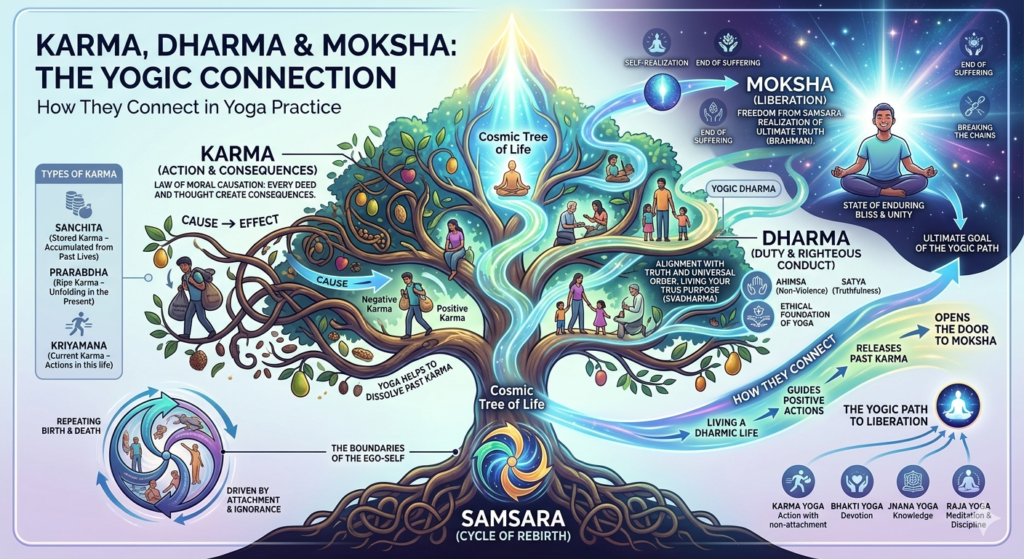
The Synthesis: How the Triad Connects
Individually, these concepts provide clarity; together, they create a technology for self-transformation. The connection between them is kinetic:
Karma is composed of our actions and the habitual tendencies we have accumulated over the years.
Karma and the filth it accumulates.
Moksha is the liberation we achieve once this cycle is broken Moksha, and we replace Karma.
Let’s say you are at a high-stake work meeting and an attendee chooses to disparage the job you’ve done.
Your Karma is the habitual response of a defensive and resentful snapback to show your discontent.
Your Dharma, after the comment, is choosing the right course of action. This could be a combination of multiple actions: taking a moment to understand the concern, formulating a response based on equanimity, and supporting it with facts.
By choosing Dharma, you are liberated from your habitual programming, Moksha.
Yoga: The Laboratory of the Self
These ideas remain intellectually stimulating unless we are physically and emotionally applying them. This is why Yoga, having both the practiced and the meditative aspect, has great significance. The mat becomes your laboratory of the self while the three currents are present.
Karma is the relentless escape when the mind chooses to find a distraction at the expense of leaving a current done with a pose. The fatigue is telling of the disintegration.
If you stay in the current, keep the breath sustained and your practice has value. Dharma has been practiced.
The power of observing reverses the process of suffering from discomfort to simply witnessing discomfort. That is the beginning of Moksha.
The Idea of Micro-Liberations
The interplay of Karma, Dharma, and Moksha is often thought to be of “large” proportions, but in truth, they exist in the format of “micro-demonstrations”. Moksha isn’t achieved, but practiced throughout our lives when we become aware instead of being swept away by our reactions.
This does not mean the aim is to reach Moksha in it’s ultimate form but, emphasized, is the process of striving toward Moksha. The moment we become aware of our actions, the repetitive actions become less automatic. The result lessens the grip that the ego has on the structures we once viewed in a rigid light as the basis for Moksha.
Start small
Identify ways you react to breaks in your stimuli.
Align with your higher self and see the thoughts and patterns and habits that keep you in your comfort zone and stuck.
The names you give to these things is not as important as clarity on the subjects and situations.
From this, as you assess your life, neurons will be building toward a more conscious self as well as a much liberated, less reacting self.