
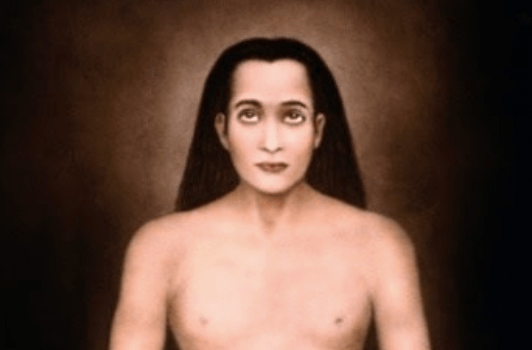
Many people, including spiritual seekers, believe Mahavatar Babaji is the fount of Kriya Yoga The practice, Kriya Yoga, is unique in that it emphasizes psychological and physiological integration, behavioral refinement, and rapid spiritual evolution, which is evidenced by the fact that most forms of Yoga emphasize purification and/or ethical/moral practice.
In this piece, we will examine the Wedji Yoga lineage: the origin, the key teachings, and the science of how this Kriya Yoga lineage evolved and adapted, and the wisdom it offered to the contemporary world.
Mahavatar Babaji: The Origin
Mahavatar Babaji is, arguably, not a historical figure in the conventional sense; he does not possess grave-sites, birth certificates, or other definitive document’s that can prove his existence.
He was first described as being a Maha-Avatar (Great Incarnation) in the presence of Lari Mahasaya in Rannikhet in 1861.
It is his intention to stay incarnate to assist in the evolution of the human divinity.
His Kriya Yoga mission was to step out of the shadows and into public awareness, to assist in the evolution of humanity. Kriya Yoga was a technique of tremendous depth and scope, but it had been lost during the collective “dark ages” of human consciousness.
Kriya Yoga crossed the divide of Eastern Mysticism and Western Pragmatism, becoming an international practice as it was taught by his direct disciple, Lahiri Mahasaya, and later, the immensely popular Paramahansa Yogananda.
What is Kriya Yoga?
Kriya is derived from Sanskrit which means ‘to do’ or ‘action’. Babaji’s Kriya Yoga refers to specific advanced techniques of Pranayama (breath control) while Kriya Yoga shares methods with Kriya Yoga in Patanjali’s Yoga Sutras, where Kriya Yoga is described as a combination of discipline, self-study, and surrender.
Kriya Yoga is most simply described as a system of action. It is the mental rechanneling of life force (Prana) in a reversible direction up and down the spine.
Transmission Lineage
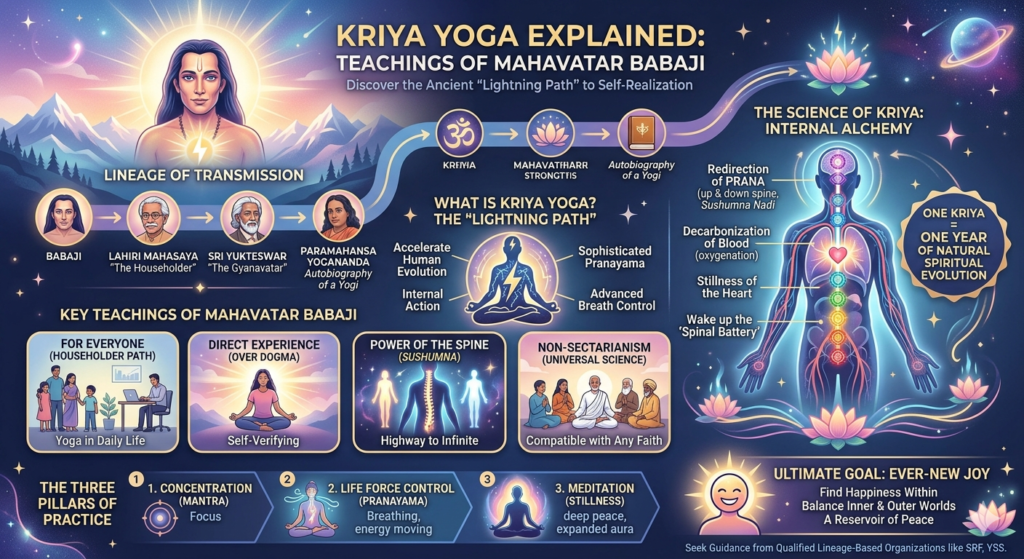
Babaji’s wisdom found its way to the present via this unique transmission line:
- Mahavatar Babaji: origin.
- Lahiri Mahasaya: the ‘Householder Yogi’ demonstrating that one can be liberated while still in a normal familial structure.
- Swami Sri Yukteswar: the ‘Gyanavatar’ (Incarnation of Wisdom) and master of Vedic astrology.
- Paramahansa Yogananda: the one who brought Kriya Yoga to the West in 1920 and wrote Autobiography of a Yogi.
The ‘Science’ of Kriya: Speeding up evolution
One of the most remarkable assertions of this lineage’s masters is that Kriya Yoga is a scientific approach to hastening human evolution.
Yogananda, in Autobiography of a Yogi, mentions that one ‘Kriya’ which is a complete cycle of energy around the spinal cord, takes about 30 seconds. The teachings state that this very short timeframe of internal energy circulation is equal to one year of natural spiritual growth attainable through a healthy, virtuous life.
How It Works
Decarbonization: The specific breathing techniques oxygenate blood and “burn off” carbon accumulated from stress of daily living.
The Spinal Battery: The yogi views the spine and brain as the “main battery” of the body. By circulating energy through the six main spinal centers (Chakras), the yogi gradually awakens the hidden power of the nervous system.
Stillness of the Heart: As energy is drawn inward, the heart rate decreases and breath becomes exceedingly still. In this state of physiological stillness, the mind naturally detaches from the senses, allowing the practitioner to perceive the “soul” or “Self.”
Key Teachings of Mahavatar Babaji
While the specific techniques of Kriya are traditionally taught from teacher to student through formal initiation (Diksha), the philosophy of Babaji can be condensed to few core points:
1. The Householder’s Path
Contrary to other traditions that encouraged seekers to escape to caves or monasteries, Babaji taught that Kriya Yoga is for everyone. Lahiri Mahasaya, Babaji’s chief disciple, was a household man with a government job and children. The teaching is clear: One does not need to give up the world to realize God; one only needs to give up the ego.
2. Direct Experience over Dogma
Kriya Yoga practice claims to achieve a form of union through action. Babaji taught that scripture reading and philosophical debates are counterproductive and almost pointless if the goal isn’t direct experience. The practice is self-verifiable. If Kriya is done correctly, then peace is felt. If not, then peace is not felt. It is a spiritual laboratory.
3. Power of the Spine
In Babaji’s teachings, the spine is a road to the Infinite. By concentrating on the Sushumna Nadi (the central energy channel), and practitioner can negate the distractions of the five senses.
4. Non-Sectarianism
Kriya Yoga, according to Babaji, is a universal science that predates all religions, and this universal science is the mechanics of the human nervous system and the universal life force. Therefore, Kriya Yoga is compatible with any religion or no religion at all.
The Three Pillars of Practice
When one is initiated into the Kriya path, the daily practice is built on three foundational pillars.
- Concentration (Mantra): focused energy of the mind.
- Life Force Control (Pranayama): the Kriya breath that directs energy through the spine.
- Meditation (Stillness): Remaining in the silence that follows the breathwork to absorb the expansion of the consciousness.
The Importance of Kriya Yoga Today
The teachings of Babaji resonate today more than ever as stress levels rise alongside screen time. Most of us are in a state of “sensory overload,” where the energy is being drawn outside to the world of screens and tasks.
Kriya Yoga teaches how to disconnect from external noise. By turning the energy inward, a reserve of peace is cultivated and can be expressed in everyday life. It helps to find the balance between the busy world and the world of spiritual depth.
Retraining the mind to direct life energy around the six energy centers up and down is claimed to produce energy. This half a minute of ‘revolt’ is said to create subtle progress in spiritual evolution. – Paramahansa Yogananda
Joy is Every Where
Joy is Ever-New and is said to be the ultimate goal of Kriya Yoga according to Mahavatar Babaji. It is not a dry, heavy-looking route, or a route of a difficult penance, but a route of finding the source of true happiness, which is not in the outside world.
If you are a curious seeker or a well-trained Hatha Yoga practitioner, the teachings of Babaji remind us to look at the most subtle channels within you. The greatest mystery is the deepest currents of your own spine.