

Yoga has many lineages, and Nath is one of the most ancient, most influential, and least understood. If you practice Hatha Yoga, you practice the Nath lineage.
This document is intended to introduce the Nath tradition. It will also provide guidance on what methods the tradition uses and why the Nath tradition remains relevant to modern practitioners.
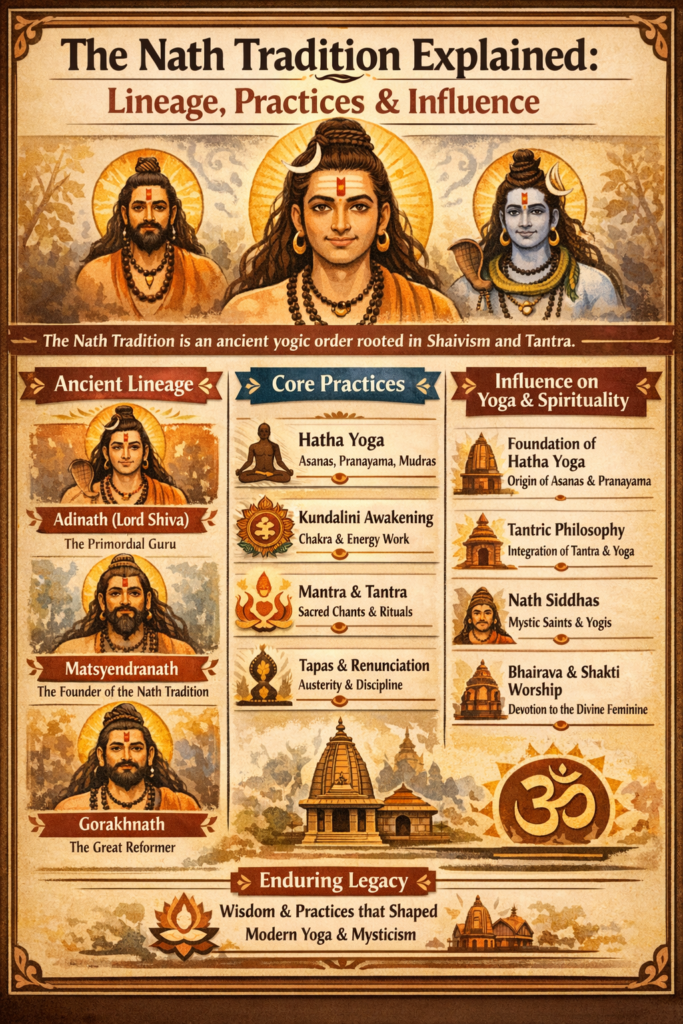
What is the Nath Tradition?
The Nath tradition is more than a belief. It is more than a philosophy. It is a lineage of transformation methods.
A Nath yogi is someone who uses technique and breath to attain a higher state of consciousness.
Origins of the Nath Tradition
The tradition is usually traced to Matsyendranath and Gorakhnath.
Matsyendranath is one of the earliest traced lineage of early yogic and tantric systems.
Gorakhnath was the most responsible for developing and disseminating the systems of the tradition.
Matsyendranath and Gorakhnath are also the two earliest known modern Hatha Yoga practitioners.
The origin of the Nath tradition is also widely believed to be in Medieval India.
The Meaning of Nath
The word ‘Nath’ roughly translates to the lord or master, more specifically; master of breath, mind and body.
Discipline and awareness are the two things that define a Nath yogi rather than their physical attributes.
The Core Philosophy of the Nath Tradition
The Nath path is practically an experiential path and the primary method is breath and body.
The Naths have a strong sense of conviction in training the body and mind. They draw inspiration from the Sankhya philosophy, Tantric philosophy and Yogic systems. The Naths like to create differentiating systems and integrate ideas from divergent schools of thought. The key practices from Nath philosophy include:
- Asanas that promote stability and endurance to sit long, remain steady, and attend to vast, expansive, meditative states until broad and calm to the point of holding one’s breath steady.
- Breath control that serves to calm one’s mind and prepare to attend to expansive and meditative states.
- Bandhas that serve to control the breath, regulate the flow of prana and calm the mind. The main bandhas are Mula Bandha, Uddiyana Bandha and Jalandhara Bandha.
- Mudras to direct prana or internal energy.
- Shatkarmas to prepare the body before further yogic practices.
The Nath yogic lifestyle paralleled asceticism in that it stemmed from simplicity, discipline and a deliberate choice of attachment, to the extent of living in caves or engaging in constant travel. Nath recognized the importance of a Guru in aiding the disciple, acting as the manual that transports the disciple through stages of accomplishing their yogic goals towards the safety of their practices.
Some people remained at monastic centers (mathas). Their aim is not isolation but to gain mastery over inner states.
These practices influenced Hatha Yoga.
The Nath Tradition has a lot of relevance for today.
There are many modern practices in Yoga that have come from this line:
- Standardized, structured, sequential practices.
- Coordinated movement and breath.
- Awareness of subtle energies.
- Discipline-based practices.
Kundalini Yoga and texts like the Hatha Yoga Pradipika clearly show this influence of the Naths.
So, also, when modern Yoga of postural practice seems different. It is still rooted in this line.
The Nath Tradition today.
The Nath Lineage exists today, but it is very at times very subtle.
Ancient teachings may be found in contemporary:
- Traditional yoga schools
- Teacher training programs
- Advanced pranayama
- Meditation techniques
Many teachers may carry aspects of this tradition, even if they do not name it as such.
Misconceptions
“Nath yogis are only ascetics”. It may be true that many followed extreme paths, but the teachings themselves are practical and adaptable.
“Hatha Yoga is merely exercise”. The modern misunderstanding is that Hatha Yoga was about for fitness. It’s about higher consciousness, not just awareness.
“The Tradition is outdated”. The discipline is immensely relevant today in a distracted world.
Why this Tradition is relevant today
The focus of modern yoga has been movement.
What the Nath tradition has to offer is purpose.
It teaches:
- a practice that is slow and steady
- awareness over achievement
- and depth over display
The focus shifts from “how it looks” to “how it feels and transforms” a lot more.
Connecting with this Tradition
You don’t have to become a monk for this.
You could start taking small steps like these:
- Taking the time to practice mindfully rather than quickly
- Focusing more on your breath rather than on the right posture
- Being more consistent with your practice rather than more intense
These may be small but capture the essence of the Nath teachings.
Final thoughts.
The Nath tradition is much more than just history. It is a foundational element of yoga, a tradition that has helped shape the practice we know today. It continues to be a source of guidance for practitioners who seek sincerity in their practice.
When you slow down, focus your breath, and observe without reacting, you are on the Nath path. Not in name. But in practice.