
The number on a yoga school’s website is rarely the number you end up paying. A 200 hour course in India might advertise €1,000. Then come the flights, the visa, the travel insurance, and a small pile of receipts for white ceremony clothes you did not know you needed. None of this is a scam. It is just the part most schools leave off the pricing page. This guide breaks down what the training itself costs in 2026, and what the whole trip actually costs once everything is added up.
How much does yoga teacher training cost in India?
A 200 hour yoga teacher training in India costs roughly €750 to €3,200 in 2026. Budget schools start near €750 with shared rooms and simple meals. Premium schools reach €3,200 with private rooms, small groups, and senior teachers. Most well reviewed programs sit between €1,100 and €1,850.
| Tier | Price | What you get |
|---|---|---|
| Budget | €750 to €1,100 | Shared room, basic meals, larger groups |
| Mid Tier | €1,100 to €1,850 | Private room, full board, experienced teachers |
| Premium | €1,850 to €3,200 | Private ensuite, small groups, senior or well known teachers |
Price tracks three things above all: the room you sleep in, the size of your group, and how experienced your teachers are. A shared dorm with twenty students will always cost less than a private room with eight. Neither is wrong. They are simply different trips.
What does the course fee actually include?
Most 200 hour training fees in India cover tuition, accommodation, and daily meals for the full course, usually around three to four weeks. Many also include a printed manual, course materials, and a completion certificate. Flights, visa, and insurance are almost never included.
Beyond the basics, inclusions vary a lot. Some schools add airport pickup, weekend excursions, or an Ayurvedic massage. Others charge for each of those separately. Read the inclusions line by line before you compare prices. Two courses listed at the same number can differ by a week of food and a private room.
Does location change the price? Kerala vs Rishikesh vs Goa

Location shifts the price more than most students expect. Rishikesh is usually the cheapest, with some 200 hour courses starting near €750. Goa runs higher, from about €1,100, thanks to beachside venues. Kerala, a safe and relaxed stretch of coast where yoga meets Ayurveda, typically costs €1,100 to €1,850.
| Region | Typical 200 hour price | Known for |
|---|---|---|
| Rishikesh | from €750 | Traditional ashram style, largest choice of schools |
| Goa | from €850 | Beach venues, Western style comfort |
| Kerala | from €900 | Ayurveda, quieter coast, surfing, the Varkala cliffs, lush nature, safety |
- I am not flexible enough.
If you are weighing Kerala specifically, we wrote a longer piece on why students choose Kerala for teacher training. For a sense of the training itself, here is what actually happens during a 200 hour course.
Wherever you train in India, it stays far cheaper than training at home. The same 200 hour certificate costs €3,200 to €5,500 in Europe and €2,750 to €6,400 in the United States. Bali sits at €2,300 to €4,100. For many European students, the flight to India still works out cheaper than a course down the road.
What about training in Bali or Thailand?
India is not the only place to train. Bali and Thailand are the most common alternatives, both known for beachside schools and warm weather. They usually cost more than India, with 200 hour courses in Bali running around €2,300 to €4,100. Thailand often lands between India and Bali on price.
The teaching in Bali and Thailand tends to lean more modern and Western, while India draws students who want the older roots of the practice. If you want to compare options in Bali, this overview of Bali yoga teacher trainings lists a range of schools and formats.
What are the hidden costs of yoga teacher training?
The hidden costs are rarely one big expense. They are a stack of small ones. Flights, a tourist visa, travel insurance, Yoga Alliance registration, and basic gear together add roughly €700 to €1,400 on top of the course fee for most European students.
| Extra | Typical cost | Notes |
|---|---|---|
| Flights to and from India | €400 to €900 | Return from Europe; more from the Americas |
| Tourist visa | €25 to €90 | Applied for online before you travel |
| Travel insurance | €50 to €150 | Per month, with medical cover |
| Yoga Alliance registration | €105 first year | Then €60 each year to stay listed |
| Gear (mat, white clothes) | €75 to €230 | Only if you own none already |
The visa is India’s electronic tourist visa, applied for through the official government portal before you fly. Here, it’s important to apply for a tourist visa for sightseeing purposes, and not for a yoga training. Registration with Yoga Alliance is optional and not required to teach, but many studios abroad ask for it. It costs about €105 in the first year and €60 to renew.
Add it all up and a course advertised at €1,400 often becomes a €2,000 to €3,000 trip. That is normal. Budget for it from the start and there are no surprises later.
Is a cheaper training worth it?
Price alone tells you little about teaching quality. What matters is the teacher to student ratio, the experience of the lead teacher, and whether past graduates actually went on to teach.
An €850 course with forty students and one teacher is cheap for a reason. You will get less feedback on your own practice, and learn less deeply. An €1,850 course with twelve students buys you attention, and more effective and efficient learning, not luxury. Before you book on price alone, read reviews, check who is teaching, and ask whether beginners are welcome. We answered that last question honestly in this post on whether beginners can join a 200H Yoga TTC.
How long should a 200 hour yoga teacher training be?
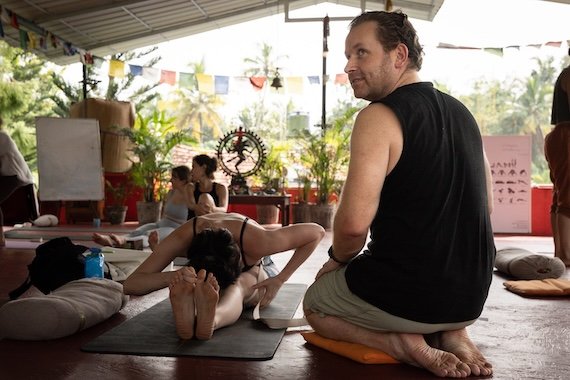
Most 200 hour trainings in India run 21 days. Devvrat Yoga Sangha spreads the same 200 hours over 28 days, one week longer than the average course. The extra week trades intensity for depth: calmer days, more time to absorb the material, and more room to bond with your group.
The length of a training shapes the experience as much as the price does. Here is how the two common formats compare.
| 21 day training | 28 day training | |
|---|---|---|
| Pace | Intensive and packed, long days | Calmer, with room to rest and absorb |
| Retention | Material can blur together when rushed | More days and more sleep to consolidate learning |
| Community | Less time to bond before it ends | Deeper connections with students, teachers, and place |
| Total cost | Lower overall | Higher overall, but often lower per day |
| Time needed | Easier to fit into a short break | Needs a longer stretch away from work and home |
There is good reason the extra week helps. Research on distributed practice shows that skills spread across more sessions, with more sleep in between, are retained better than the same material crammed into fewer days. Twenty eight days gives your body and memory more time to settle what you learn.
The longer format is not for everyone. If you cannot take almost a month away from work or family, 21 days is easier to arrange. It also costs more in absolute terms, since you pay for another week of room and food, plus another week away from earning. For some students, a shorter and faster certificate simply fits their life better.
There is a middle path. You can train in two shorter visits instead of one long stay. We also run 100 hour programs at Devvrat Yoga Sangha, each completed in about two weeks, so you can build toward your training across two trips rather than clearing a full month at once.
What does teacher training at Devvrat Yoga Sangha cost?
At Devvrat Yoga Sangha in Varkala, Kerala, a 200 hour training over 28 days costs €1,050 in a shared room and €1,500 in a private room. The 300 hour training over 30 days costs €1,410 shared and €1,710 private. Both prices include accommodation and daily meals for the whole course.
Disclaimer: these prices are updated as of July 2026. Price may have been changed by the time you read this post. Make sure to check www.devvratyoga.com for the most up to date information.
Those figures place both programs in the mid range for Kerala, with food and accommodation covered for the full stay, so the price you see is close to the price you pay. You can check current dates and what each program includes on the 200 hour training page and the 300 hour training page.
Frequently Asked Questions
A 200 hour course in India costs about €750 to €3,200 in 2026. Budget schools start near €750, mid tier schools run €1,100 to €1,850, and premium schools reach €3,200. Kerala usually sits in the €1,100 to €1,850 range.
Yes, by a wide margin. The same 200 hour certificate costs €3,200 to €5,500 in Europe and €2,750 to €6,400 in the United States. In India it rarely passes €3,200, even before the lower cost of food and stay
Flights, visa, travel insurance, and Yoga Alliance registration are almost never included. Some schools also charge extra for airport pickup, excursions, or Ayurvedic treatments. Always check the inclusions list before you book.
No. Yoga Alliance registration is optional and costs about €105 in the first year. You can teach without it. Many studios abroad prefer it, so it is worth budgeting if you plan to teach internationally.
Most European students spend €2,000 to €3,000 in total for a training of about one month. That covers the course fee, flights, visa, insurance, and small extras. A shorter flight route brings the total down.
Final Thoughts
The course fee is only ever half the story. Once flights, visa, and insurance are in the spreadsheet, most students land between €2,000 and €3,000 for the whole trip, still well below the price of training at home. Work out your full number before you book, not after, and the training itself becomes the only thing left to think about.
About the author: Louise Jongen handles enrollment and student support at Devvrat Yoga Sangha in Varkala, Kerala, where she answers questions about course costs most weeks. She was once also a 200H Yoga Teacher Training student at Devvrat Yoga Sangha in Varkala, Kerala, and is since part of the community.