
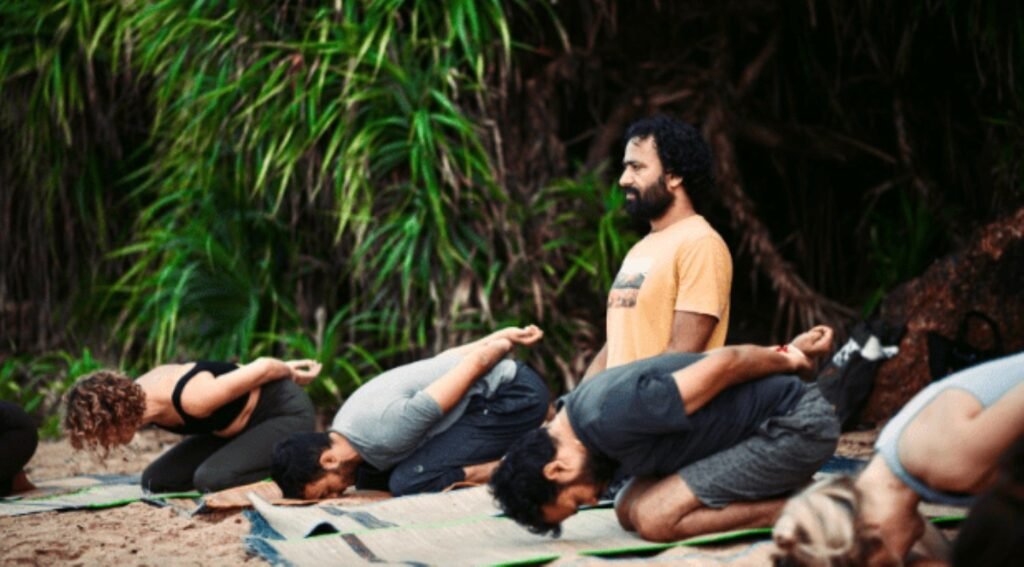
Attending an Ashtanga Yoga class means experiencing a unique sound. While in a lecture regarding the primary series or imparting in a mysore class, you will surely hear the one-of-a-kind sound that Ashtanga practitioners have popularized called Ujjayi Pranayama.
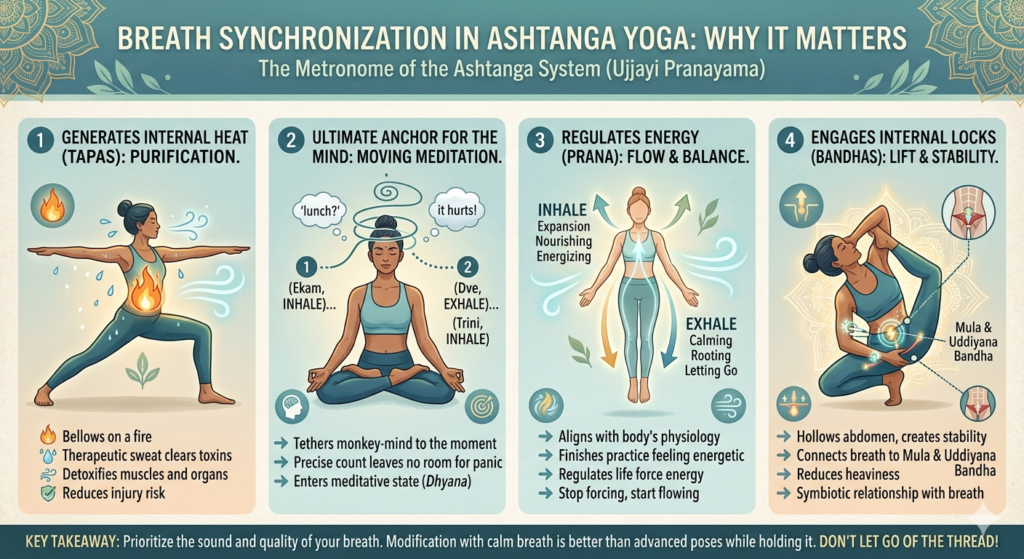
Almost all practitioners use Ujjayi breath as a “metronome” to time their Ashtanga postures. Simply, without the sound of the breath, an Ashtanga Yoga class would simply be a silent meditation class.
Breath over posture
Compared to many modern yoga classes that prioritize the asanas/postures over the breath, Ashtanga Yoga places more importance on the breath. Simply put, postures are merely shapes that the body makes while breathing, nothing more.
There’s a reason that Sri K. Pattabhi Jois emphasized breath in Ashtanga. Formerly the primary teacher of Ashtanga Yoga, he would often say, “Breathe. . .and the rest will come.” Jois was simply imparting knowledge that the practice itself, as physically demanding as it is, requires initiation with the breath.
Why does breath control matter?
Practicing yoga in a hot room with the synchronized breath control exemplifies a challenged practice, but why? Why does breath control matter, why is it significant?
In simple terms, when practitioners speak of breath synchronization, they echo all movements with a breath.
In general,
- You lift: you inhale
- You fold: you exhale
As far as breath control, it’s simply this. When practicing yoga postures or merely maintaining asanas or practicing a single posture, it becomes like a practitioner controlling their breath.
They will be following an unnoticeable rhythm that their practice is based on. In time, the practice will feel unnoticeable. Like the control of a practiced breath is a guiding rhythm, breath control becomes like the guiding hand of an unseen.
How the practice begins to change
When new students begin practicing, the movement may seem erratic, as if going through the motions mindlessly. Eventually the mind learns a calming, purposeful pattern, and the movements begin flowing seamlessly together. Breath guides the body through poses and it begins to feel less shaky, less short, and less tight. Breath keeps the mind and body connected and guides the practitioner through the practice.
When students start practicing, movement may seem erratic, as if going through the motions mindlessly. Eventually the mind learns a calming, purposeful pattern, and the movements begin flowing seamlessly together. Breath guides the body through poses and it begins to feel less shaky, less short, and less tight. Breath keeps the mind and body connected and guides the practitioner through the practice.
Your practice is your own
Even starting a practice with a friend can feel competitive and make them feel like they have to keep up, but it’s really about their unique practice and progress. Each practice will look a little different from the start and end, and as they progress, the look of their practice will progress but their breath will continue to anchor. Mindless poses and movements will start to have more and more intention.
Starting a practice with a friend may also feel competitive and make them feel like they have to keep up, but it’s really about their unique practice and progress. Each practice will look a little different in start and end, and as they progress, the look of their practice will progress but their breath will continue to anchor. Mindless poses and movements will start to have more and more intention.
Almost, but not quite enough.
And just like that, you’ve made it.
It stops you from trying to speed-run the entire practice
Your breath sets the pace
A subtle itch to move at a more hasty pace is common in Ashtanga.
A faster flow is not a better flow.
It’s a trap.
Your breath is the real speed limit in the practice,
If you listen to it,
Your movements will slow,
Your transitions will be more fluid,
You won’t just be falling into poses.
But if you ignore the limit,
Things will feel like a mess.
Where the heat actually comes from
Breath is actually the main component that builds heat in the practice.
People claim Ashtanga is a “heating practice” and while the claim is not false, the heat is not found in the rapid movements of the practice.
It’s found in the slow and steady breath.
That breath will warm your body so that the muscles open, the joints feel secure and you don’t have to be concerned about over extending.
So really, when someone says, “use your breath,” they aren’t just throwing some lame quote your way.
Ya they’re not just being poetic.
It’s your calm button. You’ll definitely need it.
When things get intense
Trust that there will be times in your practice that feel really, really intense.
At a mat with a wobbly balance, a posture that’s way too high of a level, maybe you have an energy drop, or a practice partner is just feeling really fiery. These are the moments that breath becomes the most than just a technique.
Most of the time, slow, steady breath is signaling to the body,
“You’re okay. You can hang out here for a second.”
And weirdly, that actually works to let you stay when they could have made you panic and rush out of all of it, so you stay.
That’s a skill you’ll find yourself using in real life too. During stressful situations, when arguing, in awkward moments, in all of it.
What do you think about breath work?
(I might say nothing)
I think it’s fair to say that breath work – like nothing – is often overlooked.
Some days it’s just about getting a movement your body.
Days like these sometimes have some loss and seem to take longer.
You might finish the day’s homework and feel a little “off.”
This slight loss and disconnect is often a result of breath work.
Some say something is never struck in breath work.
Still, I’m saying baby’s first movement is great.
All it takes to start is movement breath in and out and let your breath dictate your movement.
To many this may seem like enough work to start the practice.
But one day you’ll sense the change.
You aren’t setting out to finish the poses.
You aren’t breathless.
Just.
Flow.
Breath.
Then it feels like Ashtanga.
To finish up
Breath is the thread that holds everything together in Ashtanga.
So, if the breath work in your practice feels a little all over the place, out of your and your body – put off the pose for a bit. Take it together.
Rather than focusing on advanced breath control, consider prioritizing the quality of your breath and the resulting sound. You could be moving through the Primary Series with perfectly synchronized, relaxed, oceanic breath, and modifying every pose to a beginner level, but you would be doing better “Ashtanga” than someone force-binding Advanced B while holding their breath.
When you lose the breath, you lose the yoga. Keep breathing, keep moving, and let the breath lead the way.