

Have you started your day and felt like your brain is completely stuck? Have you had days where you’re completely buzzing from the coffee but manage to achieve nothing?
A yogic philosophy perspective
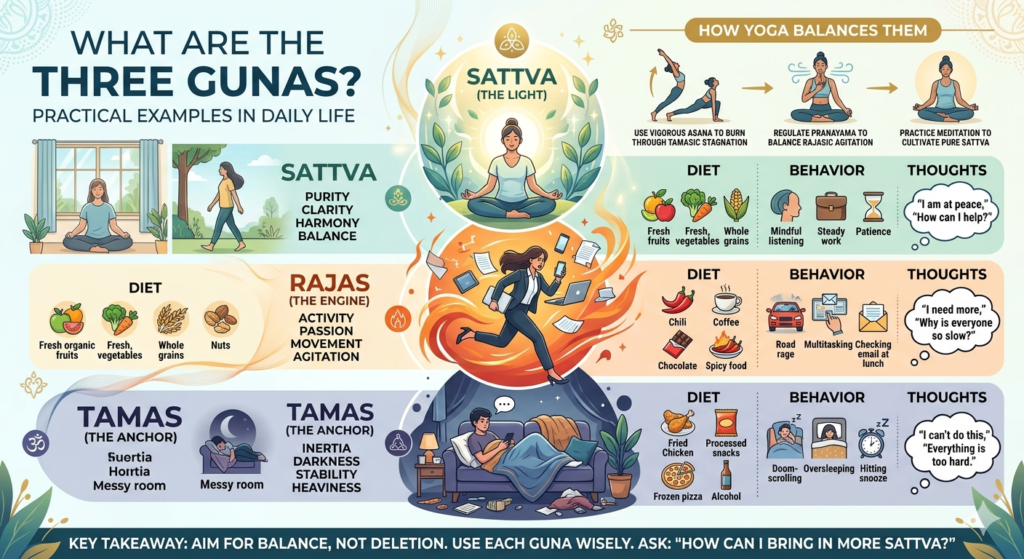
A yogic philosophy perspective these days are not just simply moods; they are Mahagunas. They describe the fundamental forces that combine and create the universe. Everything from your moods and personality to the food you eat is a combination of the Gunas.
If you understand Gunas, it’s like having the ultimate cheat code to your mind. You are finally able to “hack” your energy levels to whatever you need.
Yoga explains moods as Tamas, Rajas, and Sattva.
Starting with Tamas
Starting with Tamas- Tamas refers to all things the same and also the quality of things as unstable. Tamas provides sleep and ensures you feel grounded. But Tamas also works against you and makes you lazy and brings your brain fog.
Then we have Rajas
Then we have Rajas. Rajas is also all the things but this time is the quality of things as active and moving. Rajas provides passion and change. But too much Rajas and you feel burned and your anxiety is too active.
Examples from daily life:
- Checking emails while eating lunch
- Rushing while driving
- Feeling the need to be productive every minute of the day
Sattva (The Light)
The Quality: Purity, clarity, harmony, and balance.
This is the state of “being.” It is when you feel calm, focused, and interconnected. It is not just “peace,” but a high-vibrational state of awareness in which you see things as they are.
Examples from daily life:
- Walking in nature and feeling the tranquility of the place
- The clarity you feel after a good meditation
- Doing a good deed for its sake and not for recognition
The Gunas in your choices
The Gunas are not just in our mind, they are “invited” through the way we live.
Diet: You Are What You Eat
- Tamasic Food: Dead (heavily processed), frozen, fried, and frozen. Alcohol and onion/garlic (in excess) are considered Tamasic because they dull the senses.
- Rajasic Food: Spicy foods, coffee, and other stimulants. They provide quick but depleting energy.
- Sattvic Food: Organic fresh fruits and vegetables, whole grains (like millets), nuts, and seeds. Naturally, these foods are easy to digest and provide sustained good energy.
Thought & Behavior
Tamas
Oversleeping, procrastination, avoidance.
“I can’t do this,” “Everything is too hard.”
Rajas
Talking over people, multitasking, rushing.
“Why is everyone so slow?” “I need more.”
Sattva
Steadiness, patience, mindful listening.
Whenever someone says, “I am at peace” or “How can I help?”
Yoga seeks to bring balance.
Yoga can help balance the three states, or Gunas, that we can become stuck in.
Gunas include:
- Tamas: Lack of motivation. Usually demotivated or depressed.
- Rajas: Motivated, energized, and often frantically busy.
- Sattva: Peaceful.
Yoga can help us balance our Gunas.
Asana (Physical Practice)
Energetic Sun Salutations or a standing flow vinyasa Yoga practice can help Rajas to dispel Tamasic stagnation. Once you reach Savasana, the “fire” has cleared a path for Sattva.
Pranayama (Breathwork)
Breath is the quickest way to change Gunas. Rapid energy provoking breaths (like Bhastrika) will help to “Rajasic” and almost anxious. Out of control breathwork can help to calm the Tamasic energy. Slow, deep belly breathing also stimulates a “Rajasic” mind and can help.
Meditation
This is the ultimate tool for Sattva. By taking the time to observe and become untangled from the Gunas, you move towards your true state of being, which is pure, calm consciousness.
Conclusion:
There is nothing wrong with any of the Gunas. Yammas (rest) is just as important as Sattva (understanding/knowledge) and Rajas (activity/energy). It’s not about completely eliminating any of these states, but rather; practicing Yoga to change the state of the Gunas to ensure that they are serving you, rather than you serving the Gunas.
The next time you feel frustrated or lazy, don’t judge. Just reflect and ask yourself:
- Which Guna is at play
- And what can I do to bring in a little more Sattva?